
IBM, QuantuArt, Quantropi, Groove Quantum, Qureca, Quantum Core - The Week in Quantum Computing, May 4th 2026
Issue #280


Let us cut through it: Another week, another parade of quantum headlines—some pushing real technical substance, others circling in the press release fog, and a few reminding us why scientific adulthood means asking hard questions. Craig Gidney sets the skeptical tone right out of the gate with a post-mortem on the much-touted QDay Prize. The University of Oxford’s team makes a technical leap with the first experimental observation of ‘quadsqueezing.’ By wrangling non-commutativity and stacking multiple control forces, Oxford researchers wrung fourth-order quantum interactions from a trapped ion, more than 100 times faster than traditional squeezing methods. Meanwhile, MIT and IBM (among other institutions) have doubled down on their mutual ambitions—launching the MIT-IBM Computing Research Lab. Moving beyond their historic Watson partnership, the new lab will coordinate research across artificial intelligence and quantum computing, tying into MIT’s broader strategic initiatives for talent development and cross-discipline innovation. Shifting to the commercial front, QuantumCore has landed a healthy $1.7 million via NSERC’s Alliance Quantum grant to scale up its superconducting traveling-wave parametric amplifier work in partnership with the Institute for Quantum Computing. Quantum Art’s Series A now stands at a robust $140 million, fueled by a stable of venture supporters. Its ‘Perspective’ multicore trapped-ion architecture claims a pathway past the 1,000-qubit barrier by letting ion chains dance around dynamically. IQM Quantum Computers put an important pin on the map, securing Japan’s first enterprise quantum hardware sale: a 20-qubit system for TOYO Corporation, with both on-premises and cloud access. Over in Brussels, the European Commission has established its Quantum Computing Advisory Board (Q-CAB), helmed by Peter Zoller. The Board’s mandate is to offer technology-neutral advice on Europe’s quantum journey, develop public benchmarks, and lay groundwork for procurement and standards—sober, much-needed scaffolding for the continent’s quantum ecosystem as planning lurches toward the post-noisy era. Groove Quantum, meanwhile, puts precision hardware claims on the table with news of an 18-qubit germanium-based semiconductor spin-qubit processor—supposedly the world’s largest with this tech. Backed by €16 million in funding, Groove aims to ratchet up device scale and move to industry-grade manufacturing with help from major foundries. Here is the important part: if this path holds, mainstream chip manufacturing could finally get a foothold on quantum fabrication. Zoom out, and the global investment arms race shows no sign of letting up. According to Qureca, governments worldwide have now announced over $65.9 billion in quantum science commitments through 2026, with big ticket items from Australia, Austria, Brazil, and beyond. Everyone wants to play; the leaderboard, however, is crowded with promised budgets, not delivered results.
McKinsey Quantum Technology Monitor 2026 | McKinsey
Once more year, McKinsey renews their Quantum Technology Monitor. But if your coherence time is not that long, here is your pirate’s ready summary:
Quantum Pirates take: quantum is no longer “science fair with dilution fridges”
McKinsey’s Quantum Technology Monitor 2026 lands with a clear message: the quantum market has moved from “cool demo, bro” to “somebody is writing real budget checks.” The report calls this a commercial tipping point, and for once, that phrase is not entirely consultant-confetti.
Quick recap
More than 300 organizations are now working with quantum technology companies. McKinsey analyzed 162 of them in detail. The surprise: this is no longer mostly governments, labs, and PhDs in black turtlenecks. 72% of analyzed quantum computing customers are privately owned companies, and Europe leads adoption with 43% of the sample.
The big number: quantum computing could create $1.3 trillion to $2.7 trillion in economic value by 2035. That is the pirate treasure map. But buried treasure still requires a shovel, a ship, and not believing every parrot with a roadmap.
Where the money is going
Companies are not just “exploring.” They are spending. About one-third of surveyed companies spent more than $10 million on quantum computing initiatives in 2025, and 7% spent more than $50 million.
The money is mostly going to:
use-case development,
integration with existing tech stacks,
internal capability building.
Notably, most enterprises are not buying quantum hardware. They are leaning toward quantum-as-a-service, because owning a quantum computer today is a bit like buying a dragon: impressive, expensive, and bad for facilities management.
The three hottest use-case zones
1. Chemicals and life sciences
This is still the most credible “real quantum value” arena. Molecular simulation, materials discovery, drug screening. Classical methods approximate too much; quantum may eventually model physics more directly.
2. Travel, transport, and logistics
Optimization is the eternal quantum temptation. Routing, scheduling, supply chains, constraints. The near-term pattern is hybrid: let classical systems do most of the work, then throw the quantum goblin at the nastiest subproblem.
3. Financial services
Risk modeling, portfolio optimization, AI, cryptography, and the looming “Q-Day” problem. Finance is both excited and terrified, which is basically its default emotional state.
Investment: the rum is flowing
Quantum technology start-up investment hit $12.6 billion in 2025, which McKinsey says is 6.3x higher than 2024. Around 90% of that went to quantum computing.
But here is the catch: the money is concentrating. Roughly 60% of 2025 investment went into the top ten deals. That means the industry is starting to look less like a thousand garage experiments and more like a capital-intensive platform race.
IonQ appears as the consolidation kraken, acquiring or taking stakes in Qubitekk, Lightsynq, Capella Space, Oxford Ionics, Vector Atomic, ID Quantique, and potentially SkyWater. Translation: the market is entering its “eat or be eaten” phase.
The actual market: smaller than the hype, bigger than the hobby
McKinsey separates the huge “economic value” number from the actual internal quantum technology market: hardware, software, and services.
By 2035, that market could reach $60 billion to $100 billion, with quantum computing accounting for $43 billion to $71 billion.
That is much more sober than “quantum will eat all computing,” but still large enough to matter.
The real technical story
The bottleneck is shifting. It is no longer just “how many qubits?” The hard stuff is now:
error correction,
logical qubits,
cryogenics,
lasers,
control electronics,
manufacturing,
supply chains,
reliability,
integration.
In other words: quantum is leaving the physics lab and entering the factory. And factories are where PowerPoint dreams go to get punched in the mouth.
McKinsey is right to flag that roadmaps remain uncertain. Providers talk about hundreds, thousands, even hundreds of thousands of logical qubits in the coming years, but timelines for fault tolerance are still slippery. The sober pirate translation: progress is real; certainty is fake.
The most important sentence, in pirate form
The near-term path is not “quantum replaces classical computing.” It is:
Classical computing does the heavy lifting. AI helps orchestrate. Quantum attacks the weird, hard, ugly subproblem.
That hybrid model is the bridge between today’s limited machines and tomorrow’s possibly useful monsters.
Pirate verdict
This report is bullish, but not stupidly bullish. The signal is clear: quantum is becoming commercial. Budgets are real. Use cases are sharpening. The stack is forming. Investors are back with cannons loaded. But the warning is equally clear: most value is still ahead, not here. Roadmaps are not guarantees. Hybrid is the real game. And anyone promising magical enterprise advantage next quarter should be gently escorted off the plank.
Final take: quantum has crossed from “watch list” to “capability-building agenda.” Not because it is ready to replace classical computing, but because the companies that learn now may own the workflows, talent, IP, and partnerships when the machines finally stop being expensive physics pets and start becoming business weapons.
Quantum Bits with Quantessa & Atomique
Quantum Teleportation
Latest strip published May 3, 2026 · by Yuval Boger
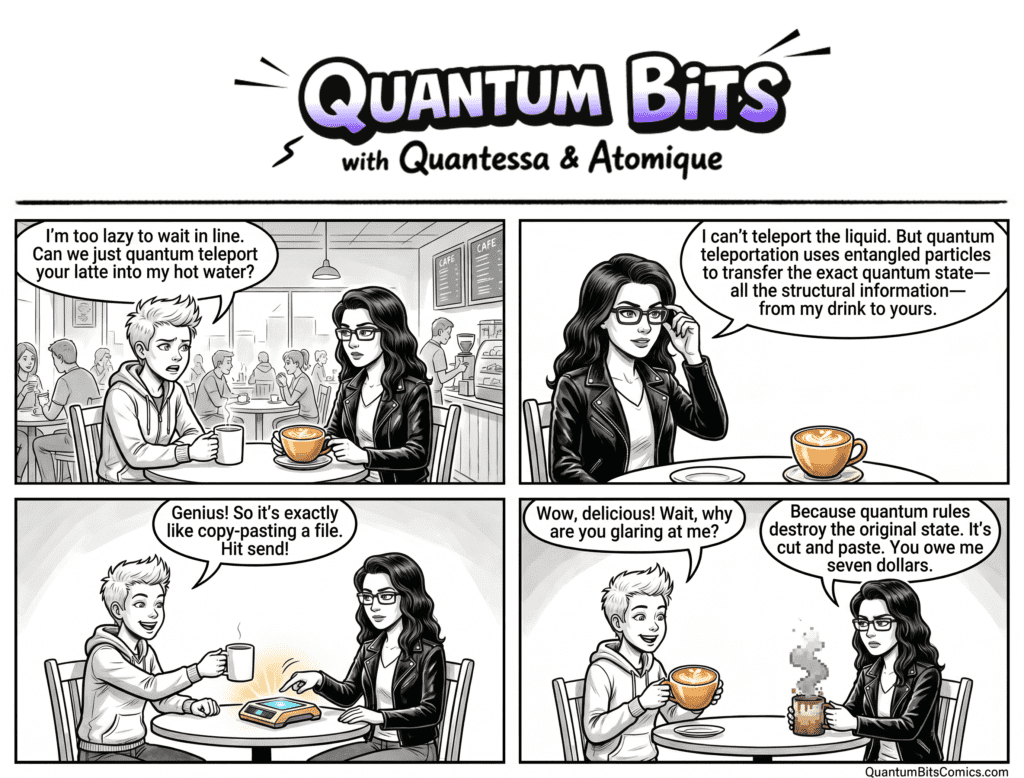
Quantum teleportation transfers the exact quantum state of one particle to another particle at a distant location, without physically moving anything between them. Despite the name, it has nothing to do with science fiction transportation. It is a precisely defined The post Quantum Teleportation first appeared on quantumbitscomics.com .
Read the full comic on Quantum Bits Comics
Craig Gidney criticizes QDay Prize for rewarding a submission that did not demonstrate genuine quantum advantage
Craig Gidney critically analyzes the QDay Prize, a competition awarding 1 bitcoin to the largest instance of Shor’s algorithm run on contemporary quantum hardware, concluding it predictably failed due to two core issues: the lack of error correction in current hardware and the irrelevance of solving small cryptographic problems. Gidney notes the winning submission succeeded using a ‘Falling with Style-style trick,’ where results from a random number generator were indistinguishable from those labeled as quantum computing, highlighting fundamental flaws in the competition design and judging. Despite Project11’s mission to promote open benchmarking, Gidney believes the prize highlighted misleading narratives around quantum cryptanalysis progress.
MIT and IBM launch MIT-IBM Computing Research Lab to advance artificial intelligence and quantum computing
MIT and IBM have launched the MIT-IBM Computing Research Lab, evolving from their previous Watson AI Lab collaboration, to expand joint research in artificial intelligence, algorithms, and quantum computing. The new lab aims to accelerate the convergence of AI and quantum technologies for applications beyond the reach of classical computing, with leadership from both MIT and IBM, including Jay Gambetta, Anantha Chandrakasan, and co-directors Aude Oliva and David Cox. The initiative will also integrate with MIT’s strategic Generative AI and Quantum initiatives, foster talent training, and advance research with broad potential for industries ranging from life sciences to finance.
University of Oxford researchers achieve first experimental demonstration of quadsqueezing quantum interaction
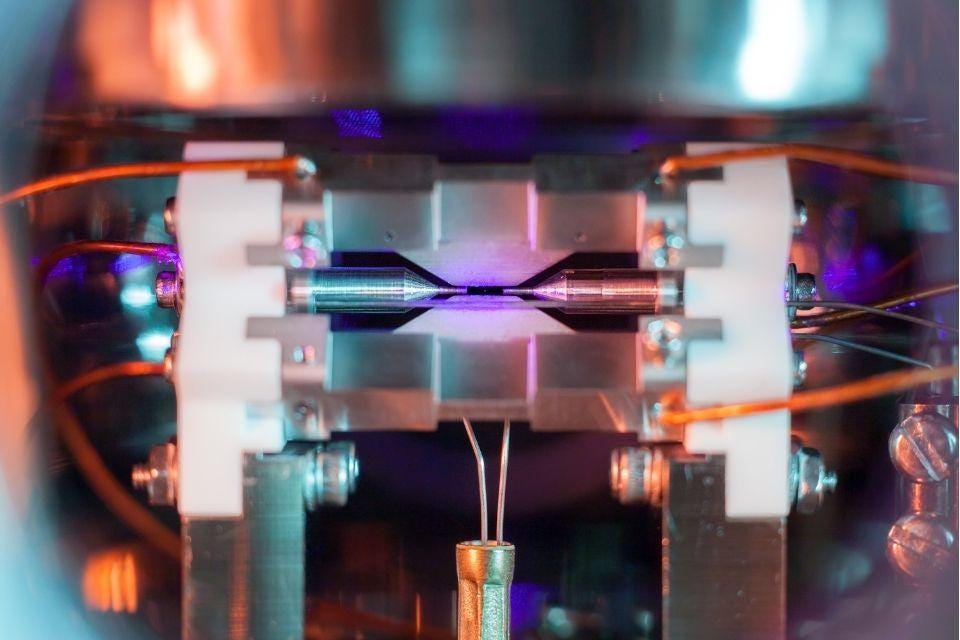
Researchers at the University of Oxford have achieved the first-ever experimental demonstration of ‘quadsqueezing’, a fourth-order quantum interaction, using a single trapped ion. By combining two carefully controlled forces in their experimental setup, the team generated increasingly complex squeezed states, including squeezing, trisqueezing, and quadsqueezing, more than 100 times faster than with conventional techniques. This approach leverages non-commutativity to enable interactions previously considered too weak to observe.
QuantumCore secures $1.7 million NSERC grant to develop quantum amplifiers with Institute for Quantum Computing
QuantumCore Inc. has strengthened its partnership with the Institute for Quantum Computing (IQC) at the University of Waterloo by becoming an industry partner in NSERC’s Alliance Quantum grant program, securing up to $1.7 million in non-dilutive funding. This grant enables QuantumCore to accelerate the development of its superconducting traveling-wave parametric amplifier (TWPA) platform, critical for advancing superconducting quantum computers.
Mandeville Ventures signs definitive agreement to acquire Quantropi Inc. in qualifying transaction - I.e. Another SPAC
Mandeville Ventures Inc. (TSXV: MAND.P), a capital pool company listed on the TSX Venture Exchange announced that, further to its press releases of December 29, 2025, March 31, 2026 and April 17, 2026, it has entered into a definitive amalgamation agreement with Quantropi Inc, an Ottawa-based cybersecurity company focused on quantum-secure data communications, dated April 24, 2026 . The Proposed Transaction is conditional upon the completion by Quantropi of the private placement of equity securities for gross proceeds of not less than US$2 million, of which approximately US$700,000 has been raised to date by Quantropi. Quantropi also plans to raise up to an additional US$5.0 million in equity financing that would be completed concurrently with the Proposed Transaction
Quantum Art raises $140 million to advance scalable multicore quantum computing architecture
Quantum Art Ltd., a quantum computing startup, has extended its Series A funding round to $140 million to accelerate scaling efforts through its innovative ‘Perspective’ multicore trapped-ion architecture. The round, which follows an initial $100 million led by Bedford Ridge Capital, expanded with investments from Hudson Bay Capital, Poalim Equity, LIP Ventures, Wolverine Global Ventures, and IDA Ventures. Quantum Art’s system enables dynamic reconfiguration of ion chains for improved scalability and computational throughput, aiming to significantly surpass the 1,000-qubit barrier.
IQM Quantum Computers to deploy 20-qubit quantum system for TOYO Corporation in Japan’s first enterprise purchase
IQM Quantum Computers has announced the sale and upcoming deployment of its 20-qubit Radiance quantum computer to TOYO Corporation, marking the first enterprise quantum computer purchase in Japan. The system will be available on both premises and via cloud, expected for delivery by the end of 2026. This matters because this move expands IQM’s presence in Asia-Pacific, where it already has systems in South Korea and Taiwan right before their SPAC-IPO.
European Commission launches Quantum Computing Advisory Board to provide independent guidance on quantum technologies
The European Commission has launched the Quantum Computing Advisory Board (Q-CAB) to provide independent, platform-agnostic advice on quantum computing in Europe. The Board, chaired by prof. Peter Zoller, consists of leading European experts including prof. David DiVincenzo and dr. Michael Bolle, and will coordinate with the European Commission and other major European initiatives. Q-CAB’s mandate includes developing assessment criteria, advising on industrialization steps, and informing investment, procurement, and standards decisions as quantum technologies move from the NISQ era toward fault-tolerant systems within two to three years.
Groove Quantum raises €16 million after demonstrating 18-qubit semiconductor spin-qubit processor
Groove Quantum, a quantum computing company spun out of QuTech, has secured €16 million in seed funding after demonstrating an 18-qubit semiconductor spin-qubit processor. The funding round was co-led by Innovation Industries and 55 North, alongside contributions from Verve Ventures and €7.5 million in equity from the European Innovation Council Fund, with an additional €2.5 million EIC Accelerator grant. Groove Quantum’s processor uses germanium-based technology that leverages standard semiconductor manufacturing processes, supporting scalable and high-fidelity quantum systems. The new capital will enable Groove Quantum to increase qubit counts, expand their team, and initiate industrial-scale manufacturing at major foundries.
Qureca report: Countries worldwide announce over $65.9 billion in quantum technology investments through 2026
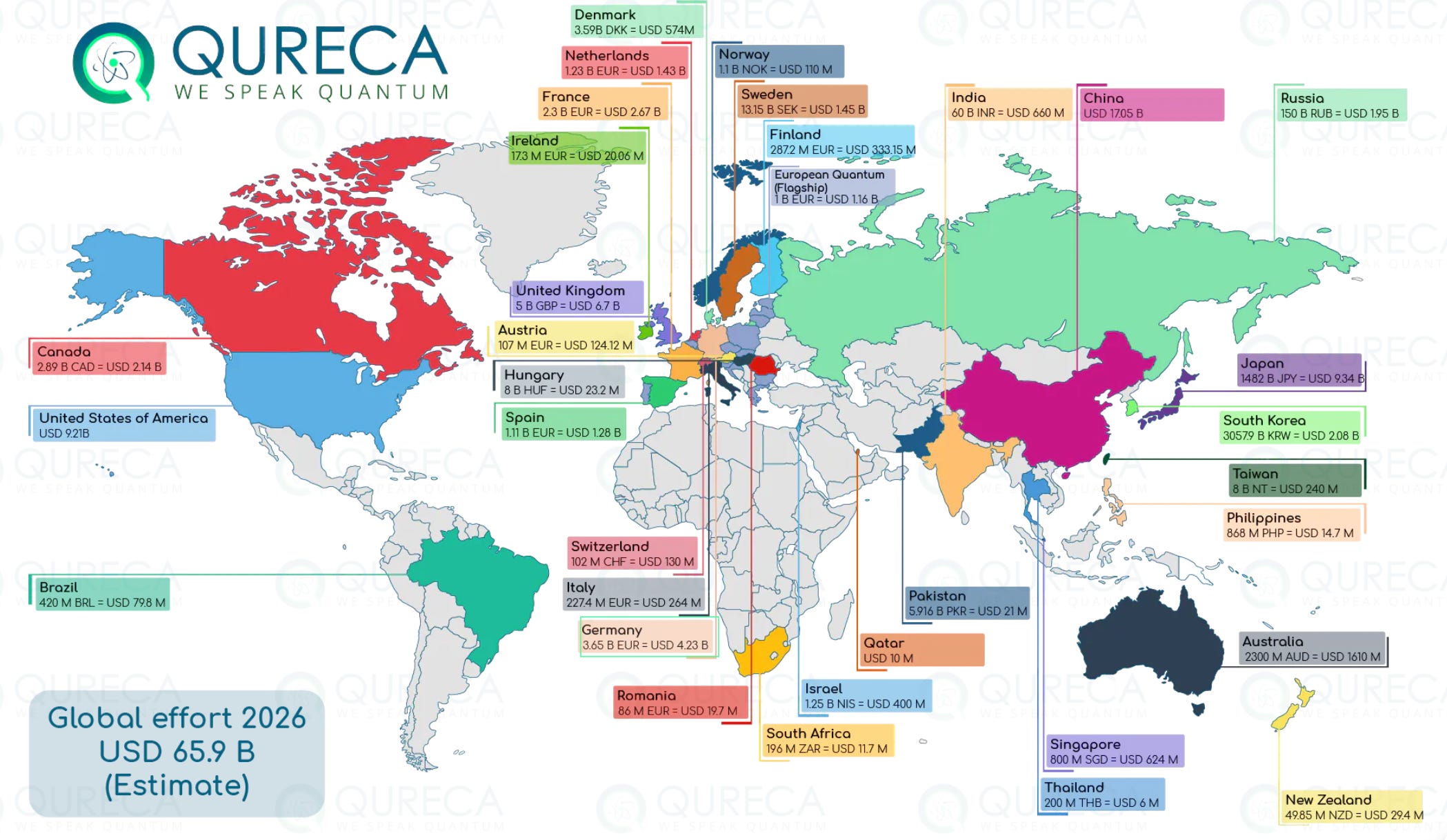
Qureca has updated their survey of global quantum initiatives, reporting that worldwide investments in quantum science and technology have surpassed $65.9 billion. The narrative outlines individual country efforts through 2026, including Australia’s AU$893 million public investment and the announcement of an additional AU$101.2 million over five years. Austria has committed €107 million through the Quantum Austria initiative, while Brazil’s collective funding for quantum programs totals over R$430 million, notably with leadership from institutions like Embrapii and Senai Cimatec.
Cloudflare makes post-quantum encryption for IPsec generally available
Cloudflare has announced the general availability of post-quantum encryption for its IPsec product, moving towards its goal of full post-quantum security by 2029. Using the IETF draft standard for hybrid ML-KEM (FIPS 203), Cloudflare has demonstrated interoperability with branch connectors from Fortinet (FortiOS 7.6.6+) and Cisco (8000 Series Secure Routers v26.1.1+). This matters the new solution protects against harvest-now-decrypt-later attacks and does not require specialized hardware, operating via software on standard processors.
US House committee advances National Quantum Initiative Reauthorization Act, highlighting IBM, IonQ, and Cisco as key beneficiaries
The passage of H.R. 8462, the National Quantum Initiative Reauthorization Act, by the House Committee on Science, Space and Technology signals a meaningful shift in U.S. quantum policy at a critical juncture for the industry (Science Space and Technology). While the original 2018 framework focused on building foundational research capabilities, the updated bill places far greater emphasis on commercialization, workforce readiness and interagency coordination- factors that could begin translating quantum potential into tangible economic activity as early as 2026.
More links this week