
IBM Quantum advantage, Claude cracks HAWK PQC, AT&T and D-Wave, ZuriQ, Multiverse- The Week in Quantum Computing, August 2nd
Issue #292

🏴☠️ Quantum Pirates Special Edition: IBM declares the “quantum advantage era.”
On July 30, IBM and several research partners released three papers claiming demonstrations of quantum advantage through trusted quantum computation. Jay Gambetta, IBM’s director of research, went further: “We are now firmly in the quantum advantage era.” [1][2]. That is a big statement. It is also a carefully engineered statement.
IBM is not claiming that its quantum computers can suddenly optimize global supply chains, discover profitable drugs or improve a bank’s trading book. Instead, it claims that quantum processors have now produced results that:
1. leading classical methods cannot reliably reproduce;
2. appear scientifically meaningful rather than purely artificial;
3. can still be trusted even when exact classical verification is impossible.
That third point is the real news. [1]
The three experiments
1. A verifiable, classically hard sampling experiment
IBM and the University of Chicago constructed a 70-qubit, depth-70 circuit containing 468 non-Clifford T gates. The computation used 97 physical qubits and a spacetime error-detection code. After post-selection, the researchers reported an approximately tenfold reduction in effective gate errors and certified a state-fidelity lower bound of 0.284 with 95% confidence. [2][3]
IBM says the quantum computation took about 15 minutes, while leading classical simulation approaches would require infeasible resources. [2]
The important nuance is that these are not 70 fully fault-tolerant logical qubits in the conventional sense used in long-term resource estimates. They are encoded, error-detected data qubits using post-selection. The distinction matters: this is an impressive intermediate error-correction experiment, but not a 70-logical-qubit universal fault-tolerant computer. [3][8]
It is also still a sampling experiment. Sampling benchmarks are excellent tests of system performance, but generally do not generate outputs a company can sell, manufacture or place on its balance sheet.
2. Discovering Floquet physics beyond reliable classical simulation
The second paper, led by Qedma with IBM, RIKEN, BlueQubit and Quantinuum, simulated the dynamics of a periodically driven Ising magnet using as many as 74 qubits on IBM’s Heron R3 processor. Qedma’s QESEM error-mitigation software produced magnetization measurements with percent-level precision and revealed long-lived oscillations in regimes where tensor-network simulations failed to converge and sparse Pauli-path calculations remained highly dependent on truncation choices. [4]
The results were subjected to several checks: independent mitigation estimators, modified noise levels, multiple IBM systems and partial cross-platform reproduction using Quantinuum trapped-ion machines. [4]
This is arguably the most scientifically interesting claim. The quantum device did not merely generate difficult random samples; it helped investigate an open question about non-equilibrium quantum matter.
But the classical comparison is subtle. The classical methods did not always produce no answer—they produced answers that disagreed or became unstable. The quantum computation is therefore being presented as the most credible estimate, supported by overlapping validation tests, rather than compared against a known exact solution. [4][8]
That is legitimate science. It is not a mathematical proof that no better classical method exists.
3. Trust without a classical ground truth
The Algorithmiq collaboration addresses the same problem more generally: what do we do when the quantum calculation enters a regime where classical algorithms disagree and no exact reference remains available?
The paper proposes a validation framework using smaller tractable instances, controlled manipulation of device noise, internal consistency tests and new observables such as an operator Loschmidt echo. The aim is to validate the process and its assumptions, rather than checking the final answer directly against a classical computer. [5]
Algorithmiq says its heterogeneous-material simulation has remained unmatched across the complete tested regime for eight months. It is also releasing its best classical method, "monoprop", so others can attack the result. [6]
This open-challenge model is healthy. IBM’s Quantum Advantage Tracker publishes circuits and results so that classical-computing researchers can attempt to overturn the claims. The project includes contributors from IBM, Qedma, Algorithmiq, RIKEN, BlueQubit, universities and national laboratories. [1][7]
So, is the claim legitimate?
Broadly, yes—but with an asterisk large enough to have its own dilution refrigerator.
The research is substantive. The experiments are large, the error-control methods are sophisticated, the classical comparisons involve serious teams and hardware, and IBM has released enough material for the results to be challenged. Cross-platform checks using Quantinuum systems make the physics claim considerably stronger than a purely self-referential IBM benchmark. [2][4][7]
IBM has also learned from the history of quantum-advantage announcements. Google’s 2019 Sycamore experiment initially claimed that a classical supercomputer would need approximately 10,000 years for a sampling task completed in 200 seconds. IBM immediately proposed a classical route requiring roughly 2.5 days, and subsequent algorithmic improvements reduced the classical cost dramatically further. [9][10]
IBM’s own 2023 “quantum utility” experiment suffered a similar fate. The original Nature paper demonstrated accurate expectation-value measurements on a 127-qubit processor at scales beyond brute-force simulation. Within weeks, researchers produced sparse-Pauli classical simulations that reproduced the results on a laptop faster than the reported quantum workflow. [11][12][13]
That did not make the quantum experiments worthless. It made classical algorithms better. Quantum-advantage claims are not Olympic records carved in stone; they are invitations to a particularly nerdy bar fight.
The new IBM work is more defensible because verification is built into the experiments and because the physics results are supported through several independent tests. However, all three papers are recent preprints and have not yet received the level of external scrutiny that follows a high-profile claim over several months. [3][4][5][8]
The correct conclusion today is therefore:
“IBM has presented credible evidence of quantum computational advantage over the classical methods tested so far. It has not demonstrated permanent advantage over every possible future classical method.”
Does this mean quantum computing will hit corporate P&Ls?
IBM CEO Arvind Krishna says quantum computing could begin making a measurable contribution to IBM’s revenue and profit around 2028 or 2029. He has also discussed the possibility of quantum creating approximately $1 trillion of value by the end of the 2030s. [14]. Nothing in these three papers proves that forecast.
The experiments involve quantum magnets, heterogeneous model systems and structured circuit sampling. They do not calculate the economic value of a drug candidate, reduce the cost of industrial production, outperform commercial optimization software or show a total workflow that is cheaper than using CPUs and GPUs. [3][4][5][8]
In fact, the relevant economic comparison must include:
Quantum hardware access
Calibration and queueing
Repeated circuit execution
Discarded runs from post-selection
Error-mitigation overhead
Classical preprocessing and post-processing
Specialist labour
Cost of validating the answer
A 15-minute quantum circuit is not necessarily a 15-minute business solution.
There is nevertheless a plausible line from this research to future commercial value. Materials science and chemistry are among the domains where classical simulation becomes expensive precisely because nature itself is quantum mechanical. Reliable quantum simulation could eventually accelerate the search for catalysts, battery materials, superconductors and molecular structures.
But “could influence scientific R&D” is several steps away from “will improve next quarter’s operating margin.”. IBM may still see P&L impact by 2028–2029 through selling access, consulting, software and infrastructure, even if its customers have not yet generated superior business outcomes. Vendor revenue is not the same thing as customer quantum advantage.
What should companies do now?
Do not rewrite the corporate strategy deck around Thursday’s press release. Also do not dismiss the result. Companies with genuine exposure to computational chemistry, materials, condensed-matter physics or high-value scientific modelling should now move from generic quantum education toward disciplined benchmarking. That means identifying expensive classical workloads, preserving data and model pipelines, and testing full hybrid workflows—not celebrating qubit counts.
Every future claim should be subjected to four separate questions:
Is it classically hard? Hard compared with which algorithms, on which hardware, under which accuracy requirement?
Is the result trustworthy? Is there direct verification, statistical certification, cross-platform reproduction or only extrapolation from easier instances?
Is the problem useful? Does the output answer a scientific or business question, rather than simply proving that the processor can execute a difficult circuit?
Is there economic advantage? Is the end-to-end workflow faster, cheaper or more accurate after including mitigation, orchestration, classical compute and human expertise?
IBM has made meaningful progress on the first two questions. The second paper begins to address the third. None of the papers settles the fourth.
The Quantum Pirate verdict
IBM’s announcement is not vaporware, and it is stronger than many previous quantum-supremacy claims. The shift from “our result is too difficult to check” toward “here is why you can trust it anyway” is an important intellectual and engineering advance. But declaring a universal “quantum advantage era” is premature.
We may be entering an era of repeatable, scientifically credible advantage candidates: quantum computations that survive serious classical comparison, produce new physical insight and include explicit validation frameworks. That is a real milestone.
But it is not yet the era of quantum EBITDA. Keep the champagne cold. Do not open it until someone shows the invoice, the classical alternative and the measurable business result.
Sources and references
[1] Kandala, A., Javadi-Abhari, A. and Gambetta, J. “Researchers demonstrate quantum advantage through trusted quantum computation.” IBM Quantum Blog, 30 July 2026. IBM’s overview of the three experiments, its definition of quantum advantage and the Quantum Advantage Tracker.
[2] IBM and the University of Chicago. “IBM and The University of Chicago Demonstrate Quantum Advantage, Establishing Trusted Quantum Computation on Logical Circuits.” IBM Newsroom, 30 July 2026. Contains IBM’s description of the 70 encoded qubits, 2,415 logical two-qubit operations, 468 T gates, tenfold error reduction and approximately 15-minute execution.
[3] Martiel, S. et al. “Sampling Hard Circuits with Verifiably High Fidelity.” arXiv:2607.25941, July 2026. Primary preprint for the IBM–University of Chicago doped-Clifford sampling and spacetime-code experiment.
[4] Leviatan, E. et al. “Resolving Structure in Prethermal Floquet Dynamics with Precision Quantum Computation.” arXiv:2607.24937, July 2026. Primary paper for the Qedma-led 74-qubit Floquet experiment, classical comparisons and Quantinuum cross-platform checks.
[5] Maniscalco, S. et al. “Observable Estimation in the Absence of Classical Verification.” arXiv:2607.25998, July 2026. Primary paper describing the Algorithmiq validation framework and operator Loschmidt echo.
[6] IBM and Algorithmiq. “IBM and Algorithmiq Demonstrate Quantum Advantage, Establishing a Framework for Trusted Quantum Computation Beyond Classical Verification.” IBM Newsroom, 30 July 2026.
[7] Quantum Advantage Tracker. Public benchmark repository and challenge platform for candidate quantum-advantage experiments, classical responses, circuits and datasets. The tracker treats entries as active claims subject to further challenge rather than permanently settled results.
[8] Ivezic, M. “IBM Claims ‘Trusted Quantum Advantage’ With Three Simultaneous Papers. Here’s What the Numbers Actually Show.” PostQuantum.com, 1 August 2026. Independent critical analysis distinguishing error-detected data qubits from fully fault-tolerant logical qubits and scientific advantage from commercial utility.
[9] Arute, F. et al. “Quantum Supremacy Using a Programmable Superconducting Processor.” Nature 574, 505–510, 2019. Original Google Sycamore quantum-supremacy paper.
[10] Pednault, E. et al. “Leveraging Secondary Storage to Simulate Deep 54-Qubit Sycamore Circuits.” IBM Research preprint, 2019. IBM’s proposed classical simulation strategy challenging Google’s original 10,000-year runtime estimate.
[11] Kim, Y. et al. “Evidence for the Utility of Quantum Computing Before Fault Tolerance.” Nature 618, 500–505, 2023. IBM’s 127-qubit quantum-utility experiment.
[12] Begušić, T. and Chan, G. K.-L. “Fast Classical Simulation of Evidence for the Utility of Quantum Computing Before Fault Tolerance.” arXiv:2306.16372, 2023. Demonstrated sparse-Pauli classical reproduction on a laptop.
[13] Begušić, T. et al. “Fast and Converged Classical Simulations of Evidence for the Utility of Quantum Computing Before Fault Tolerance.” Science Advances, 2024. Peer-reviewed follow-up presenting several classical methods capable of reproducing the IBM observables.
[14] Swayne, M. “IBM CEO Expects Quantum Computing to Drive Revenue by 2020s, Trillion-Dollar Value by End of 2030s.” The Quantum Insider, 31 July 2026. Reports Arvind Krishna’s expectations for measurable revenue and earnings impact in 2028–2029 and approximately $1 trillion of value by the end of the 2030s.
—
Plenty of big claims this week. We have already talked plenty about IBM Advantage claims, so lets move on. Anthropic’s researchers used their Claude Mythos AI to expose fresh cryptanalytic weaknesses: HAWK, a post-quantum digital signature candidate, lost serious key strength in 60 hours of mostly hands-off AI work—raising flags for NIST and the rest of us. Over in China, the government is pushing quantum tech out of the lab and into the power grid, rolling out nationwide after a successful pilot that promises fewer blackouts and better grid resilience. On the industry and investment front, AT&T doubled down on D-Wave, signing a new deal to push annealing hardware into real-world network operations—think outage detection and technician routing—with an eye on future gate-models for quantum-safe networking. Q-CTRL boasted a software integration that made quantum materials simulation 3,000 times faster than the classical best, shrinking 100 hours of work to just two minutes on IBM hardware. The Pittsburgh Supercomputing Center scored $5 million from the National Science Foundation to build TangleLab: a quantum-classical testbed with partners Hewlett Packard Enterprise and Rigetti—good for workforce training and actually figuring out hybrid workflows. EY Canada is rolling out an on-site, enterprise-dedicated quantum machine as part of their $3 billion bet on AI and quantum, aiming for use cases where regulatory control and data locality trump cloud convenience. Zuriq rased a capital round from Quantonation amongs others and Multiverse went full into AI becoming a Spanish unicorn (remember it was a quantum company?)
Quantum Bits with Quantessa & Atomique
Deutsch Jozsa Algorithm
Latest strip published August 2, 2026 · by Yuval Boger
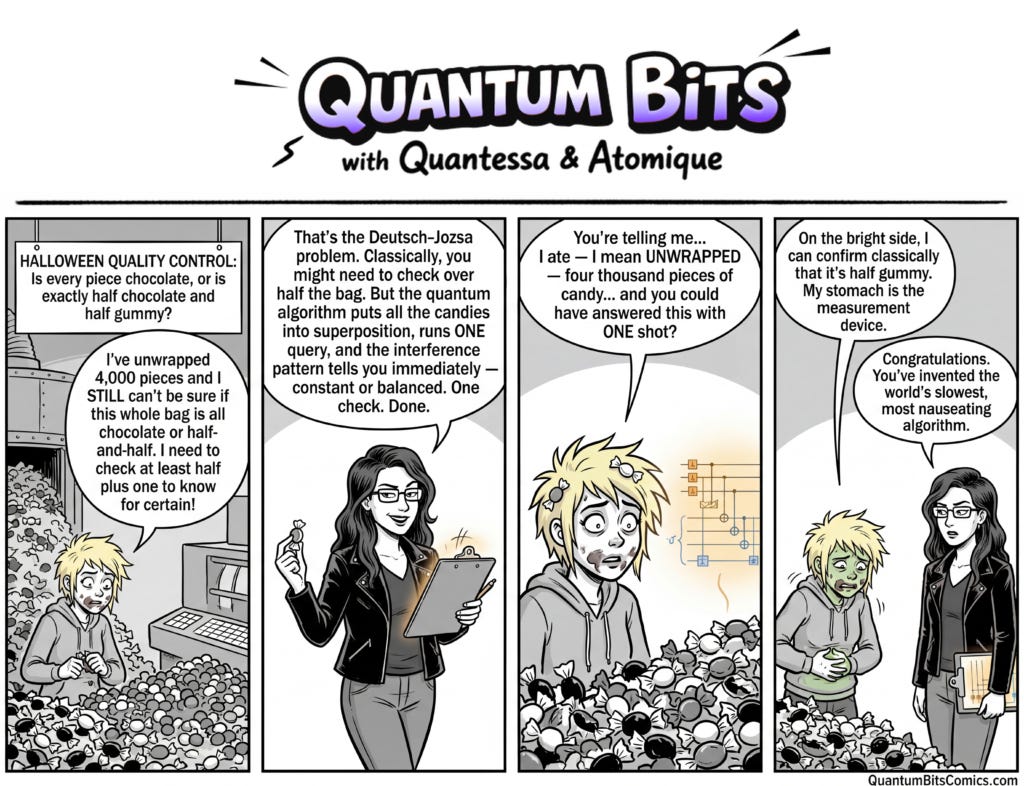
In 1992, physicists David Deutsch and Richard Jozsa posed a deceptively simple question. Imagine you have a black box containing a function that takes a string of bits as input. This function is guaranteed to be one of two types: The post Deutsch Jozsa Algorithm first appeared on quantumbitscomics.com .
Read the full comic on Quantum Bits Comics
Pasquale Scarlino’s team develops faster, hardware-efficient superconducting qubit readout architecture
Researchers at EPFL, in collaboration with the University of Sherbrooke, have created an improved method for reading superconducting quantum bits (qubits) that achieves faster and more accurate measurements while simplifying hardware requirements.
Related coverage: A way to read quantum bits faster and with less hardware
Anthropic researchers use Claude Mythos to discover new attacks on HAWK and reduced-round AES cryptographic algorithms
Anthropic researchers, using their Claude Mythos Preview AI system, have achieved two notable cryptanalysis results. The first is an improved attack against HAWK, a candidate post-quantum digital signature scheme under review by NIST, where Claude was able to halve the effective key strength in about 60 hours of largely autonomous work — raising concerns about HAWK’s candidacy and highlighting the need for revised key sizes. Anthropic has also released a benchmark to facilitate wider study of large language models in cryptanalysis.
QURECA, TEC12, and INEXSU to organize fourth Quantum Latino conference in Medellín

The fourth edition of Quantum Latino, the largest quantum event in Latin America, is scheduled for October 21-23, 2026, as a hybrid conference in Medellín, Colombia. Organized by QURECA, TEC12, and INEXSU, the event aims to raise awareness and promote quantum technologies while fostering a connected quantum community across the region. Over three days, the conference will convene researchers, entrepreneurs, startups, and industry collaborators for learning, discussion, networking, and collaboration, complemented by an industry exhibition.
China to implement quantum technology nationwide to improve power grid reliability after successful trial
China is set to widen the use of quantum technologies, including highly precise sensors and advanced computer simulations, throughout its power grid after an 18-month pilot project in Hefei, Anhui province proved successful. Quantum technology, which leverages the ability of atomic-scale systems to exist in multiple states simultaneously, has transitioned from laboratory research to practical applications, offering speed, precision, and enhanced security. Based on the trial’s success, the technology will now be implemented nationwide with the goal of reducing blackouts and supporting future power grid development.
Multiverse Computing announces $570 million Series C funding round to expand efficient AI solutions

Multiverse Computing announced a $570 million (€500M) Series C funding round at a $1.7 billion (€1.5B) pre-money valuation, a 5x step-up from its Series B. The round, advised by JP Morgan and Santander CIB, is expected to bring total funding to $800 million, inclusive of prior rounds, and may remain open to select additional strategic investors. Since closing its Series B in June 2025, Multiverse Computing has grown annualized revenue by more than 10x, with 96x year-over-year sales growth in Q1 of 2026, reaching a run rate that positions the company among the fastest-growing AI labs and infrastructure businesses in Europe. Multiverse switched from quantum inspired algorithms to compressed LLMs in the era of AI.
AT&T signs agreement to expand use of D-Wave quantum computing technology in network operations
AT&T has signed a new agreement to expand its adoption of D-Wave’s quantum computing technology, focusing on integrating D-Wave’s annealing systems into network operations. The expanded partnership aims to apply quantum solutions to broader use cases such as outage detection, technician routing, network planning, and traffic management, supporting AT&T’s efforts to modernize its converged fiber and 5G network amid growing AI-driven demands. Additionally, AT&T is evaluating D-Wave’s forthcoming gate-model quantum systems for potential use in quantum security and communications, indicating a long-term move towards advanced computational capabilities within its broader innovation strategy.
Related coverage: AT&T Signs Agreement to Expand Use of D-Wave’s Quantum Computing Technology Across Network Operations
Pittsburgh Supercomputing Center to build TangleLab hybrid supercomputer for quantum-classical research
The Pittsburgh Supercomputing Center will develop TangleLab, a hybrid quantum-classical computing platform, with $5 million in funding from the National Science Foundation. This initiative, involving partnerships with Hewlett Packard Enterprise and Rigetti Computing, aims to provide researchers, students, and educators hands-on access to integrated quantum and classical systems. TangleLab, set to begin construction in September 2026 and open fully in 2027, will serve as a national testbed for exploring how quantum computing can be effectively combined with traditional high-performance computing. The platform will inform the design and management of future computing architectures and support workforce training in quantum technologies, while giving users access through a competitive proposal and supported onboarding process.
ZuriQ raises $25.5 million seed round to develop scalable quantum chip architecture
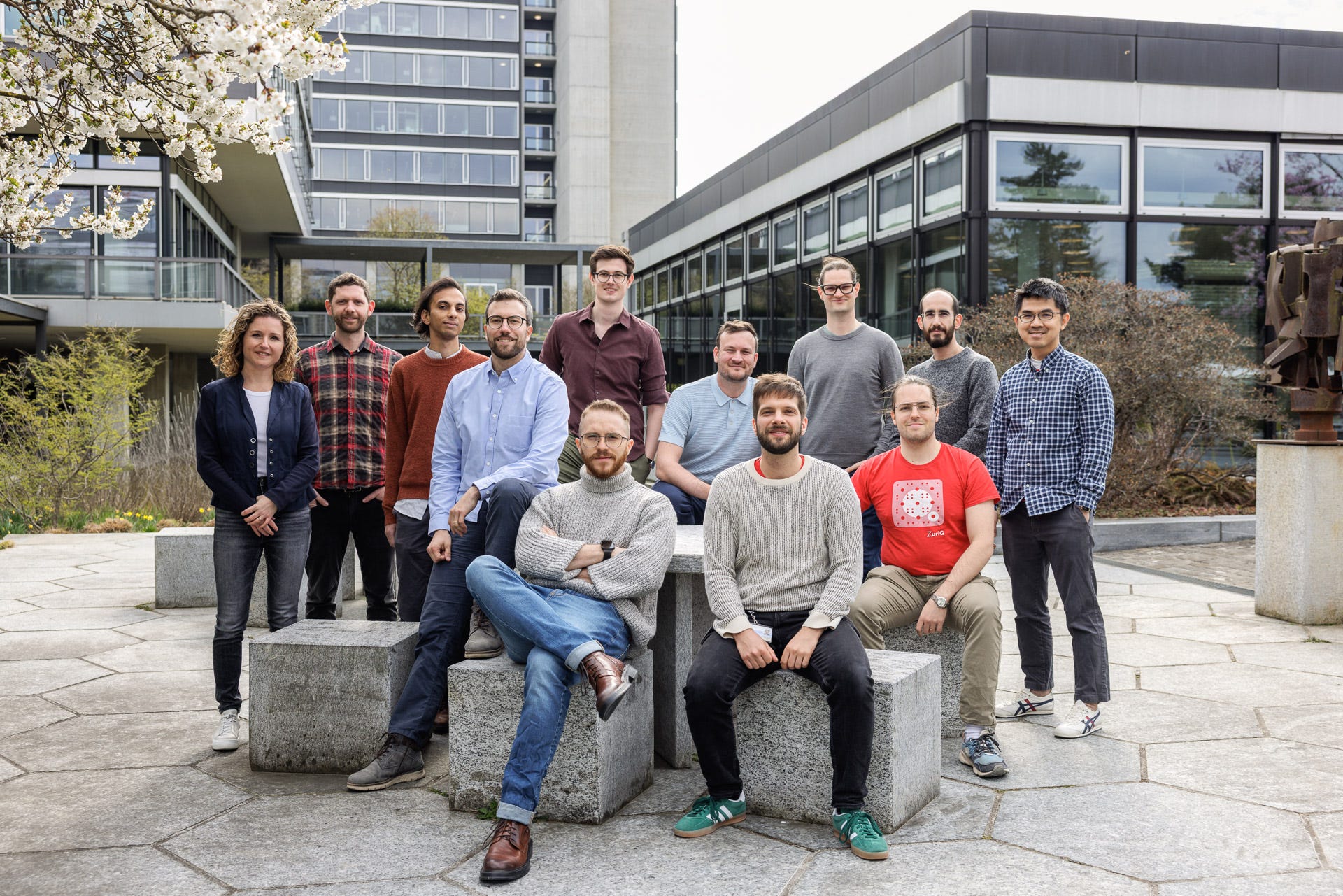
ZuriQ, a Swiss quantum computing company spun out of ETH Zürich, today announced it has raised $25.5 million in seed funding to scale its trapped-ion quantum processors. The round builds on the company’s $4.2 million pre-seed round in 2025 and is led by Quantonation, with participation from Forward.one, Extantia, Firgun Ventures, and all previous round investors. ZuriQ will use the new capital to expand its team alongside research and development efforts as it works to significantly increase the number of qubits its architecture can support.
Q-CTRL accelerates quantum computing adoption with software integrations enabling enterprise capability, deployability, and usability

Commercial quantum computing is moving beyond technical milestones to a focus on delivering tangible business value for customers. Q-CTRL recently demonstrated that integrating its software with IBM Quantum infrastructure enabled a materials simulation to be completed 3,000 times faster than leading classical solvers, reducing compute time from 100 hours to two minutes. As usability, deployability, and operational integration improve, enterprises are preparing for broader quantum utility, with positive returns in sectors such as defense and advanced simulation anticipated as early as 2027.
Ernst & Young expands quantum computing capabilities with on-site quantum computer led by EY Canada
EY has announced the deployment of an on-site quantum computer, led by its Canadian division, as part of a broader investment exceeding US$3 billion in artificial intelligence and advanced technologies. The new quantum capabilities are intended to handle sensitive workloads such as optimization, fraud detection, data protection, and risk management, giving EY more direct control over data residency and application development. This move aims to accelerate the integration of quantum and AI for enterprise clients, transitioning quantum technology from concept to practical deployment and addressing regulatory and security requirements more effectively than cloud-based options.
IBM and University of Chicago achieve quantum advantage with 70 logical qubits and error correction
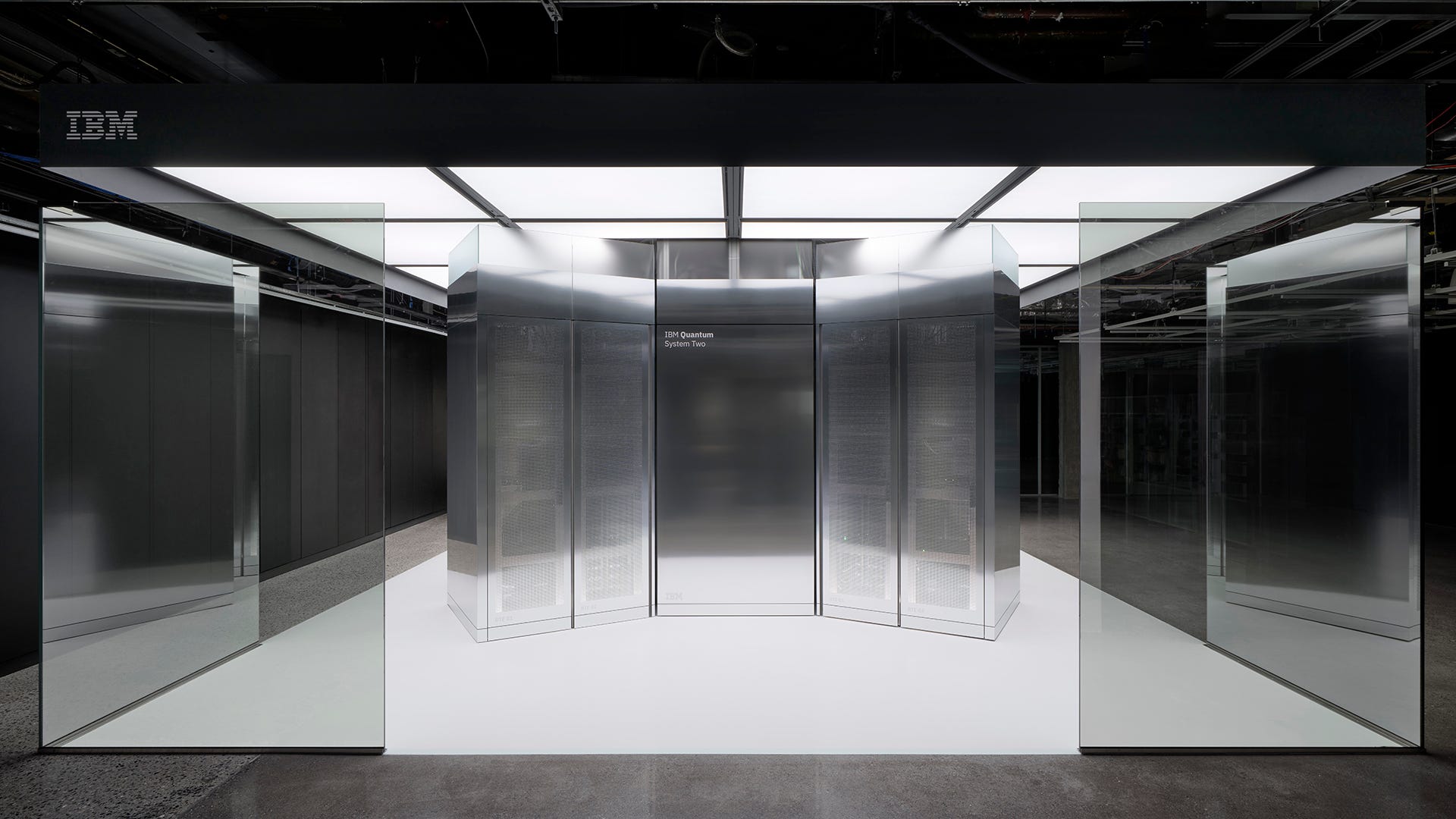
IBM and the University of Chicago have demonstrated quantum advantage using an innovative error correction scheme that allowed them to encode 70 logical qubits and solve a classically intractable problem in about 15 minutes.
IBM and Algorithmiq demonstrate quantum advantage with a framework for trusted computation beyond classical verification
IBM and Algorithmiq have announced a significant quantum computing milestone by jointly demonstrating quantum advantage through simulating heterogeneous quantum materials on IBM quantum hardware. Importantly, the team addressed the longstanding issue of verification by creating a new framework for trust in quantum computation when classical checks are not possible. As part of this advance, Algorithmiq released its leading classical simulation tool, enabling independent benchmarking and validation throughout the research community.
IBM CEO Arvind Krishna projects quantum computing will measurably impact company earnings by 2028 or 2029
IBM CEO Arvind Krishna announced that the company’s quantum computing investments are projected to have a measurable effect on its revenue and earnings by 2028 or 2029. Krishna said IBM expects the technology to generate a trillion dollars in value by the end of the 2030s, citing new research with startup Algorithmiq that demonstrates quantum computers’ superiority over classical systems for certain problems. Despite skepticism over the technology’s commercial readiness due to challenges like high error rates and scalability, IBM has pledged $1 billion alongside U.S. Government investment to develop a quantum chip foundry, highlighting substantial progress and ongoing industry competition.
Terra Quantum and Apex.AI implement NIST-standardized post-quantum cryptography for secure cloud communication in software-defined systems
Terra Quantum and Apex.AI have jointly demonstrated the use of NIST-standardized post-quantum cryptography to enable secure communication between software-defined robotic systems and cloud-based control platforms. The companies highlight the relevance of this work for industries managing assets with long service lifespans, where resilience against future quantum-enabled attacks is critical.