
Microsoft, Quantinuum, University of Washington, Pasqal, Xanadu, IQM - The Week in Quantum Computing, June 15th 2026
Issue #286

Breakthroughs in quantum error correction and hardware integration set the pace this week, while fresh capital and government interventions underscore the race to turn prototypes into industrial footholds. Is any of this real progress, or are we just adding more frosting to the hype cake? Let us cut through it. On the scientific front, Microsoft and Quantinuum threw down the gauntlet in Nature, claiming error-rate reductions up to 800x over physical baselines for trapped-ion systems—specifically, an 800x gain in logical Bell-state prep, a 51x cut per error-correction round, and a 22x improvement for 12-qubit cat state preparation. All achieved by fusing Microsoft’s error-correction know-how with Quantinuum’s noisy but scalable hardware. The results: logical errors down to levels that, for once, do not look immediately laughable compared to their physical qubits. Impressive science. Dubious timeline to fault-tolerant workloads, but at least it moves the conversation past “if error correction” to “how soon and how much.” This happens right after Microsoft unveiled Majorana 2 and Quantinuum went public. In Quantum you have to keep all options open. Meanwhile, University of Washington researchers signaled another pivot, combining artificial intelligence and quantum computing to accelerate quantum materials simulation. Their work shows AI handling large, many-layer molybdenum ditelluride stacks with speed and, crucially, discovering quantum phenomena invisible at the single- or few-layer scale, while quantum computers take on the more stubborn quantum phenomena—think Laughlin states—head-on. IBM, never eager to be sidelined in the race for scientific relevance, introduced the open-source ffsim Python library for fermionic quantum circuits. Their benchmarks show up to an 11× speedup (and major memory savings) compared to more generic simulators like FQE, letting you prototype on 64-qubit 2D Hubbard models without melting your server rack. The secret sauce: symmetry exploitation—finally, something other than another cloud dashboard. Moving from the lab to the fab, Pasqal quietly turned the key on Italy’s first neutral-atom quantum computer at CINECA, dropping a working 140-qubit Orion QPU directly into the EuroHPC Leonardo supercomputer. Unlike the PowerPoint “roadmaps” elsewhere, this is real, funded deployment. The system is fully hybridized with classical HPC scheduling, not stranded in a corner. That makes three such Pasqal deployments in Europe, and a strong signal that continental hardware integration is leaving the talking phase. Money—never as patient as scientists—shifted again this week. IQM Quantum Computers and Real Asset Acquisition Corp. reported an upsized USD 146 million private investment in public equity round, thanks largely to Ilmarinen, Finland’s heavyweight pension insurer. The fresh capital is earmarked for the race to fault-tolerance: credible, if you believe the milestone claims from other hardware vendors. In Sweden, Arkeon Technologies bagged a €594k seed round led by local Ventures, betting that their post-fabrication qubit tuning can boost superconducting chip yields—thirty interested companies on paper, but the proof will be in whether anyone pays real money for hardware. On the macro stage, Italy formally rolled out its National Quantum Strategy, underpinned by over €140 million via the National Recovery and Resilience Plan, and established two specialized national centers. Actual budget and targets lag continental heavyweights Germany and France, but Italy’s ecosystem is already drawing international hardware players and carving out early strengths in quantum communication and photonics. Lastly, preventative action made a rare showing in the wild west of quantum cybersecurity claims. Colt Technology Services and Ciena completed a quantum-safe transatlantic data trial, encrypting real data over nearly 7,000 kilometers between New York and London at 800 Gb levels. They used Ciena’s WaveLogic 6 Extreme with freshly NIST-standardized Module-Lattice-Based Key Encapsulation and Quantum Key Distribution interworking. The real value is twofold: proof that these countermeasures work at scale, and a public acknowledgment that quantum risk is not a sci-fi concern but a real headache for anyone moving serious data undersea. Put simply: viable error correction on real hardware, faster and cheaper simulation tools, and hardware actually landing in supercomputing centers with government coin at their backs. If there is a clear implication across these stories, it is this: the quantum sector is (finally) shifting experimental credibility and early-scale deployment out of the paper and into the infrastructure—one careful increment at a time.
Quantum Bits with Quantessa & Atomique
Fault Tolerant Computing
Latest strip published June 14, 2026 · by Yuval Boger
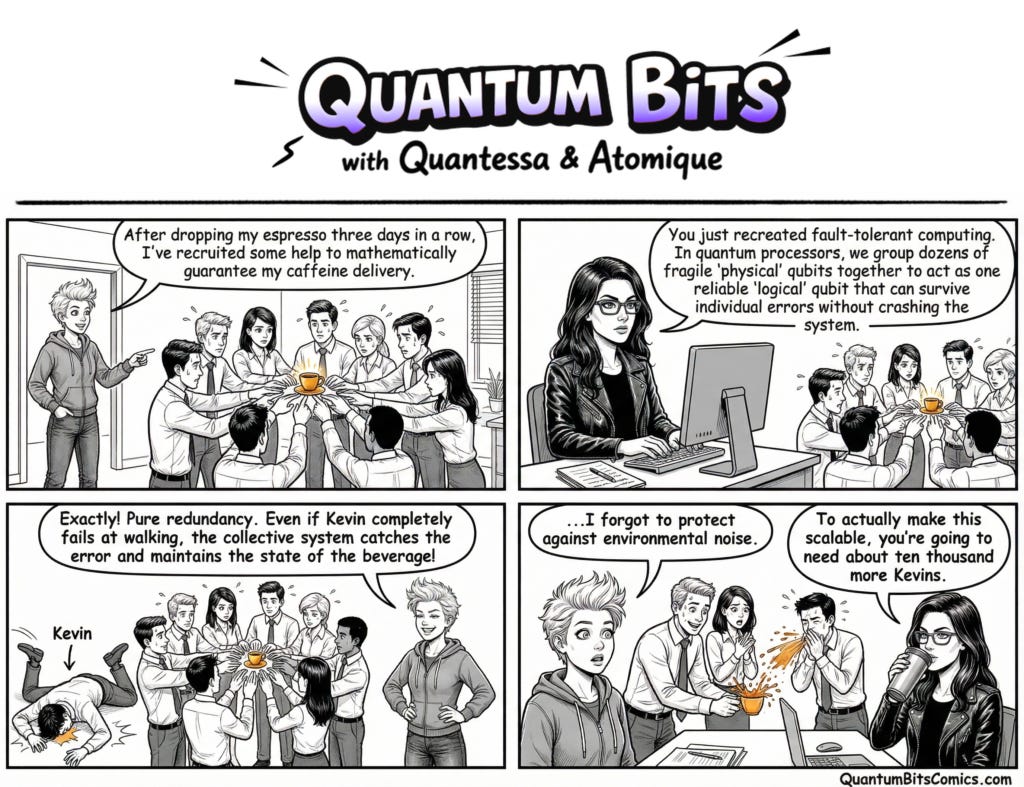
A fault-tolerant quantum computer is a machine that can perform arbitrarily long calculations even though its underlying components are unreliable. In a classical computer, transistors rarely fail, but quantum bits are entirely different. Regardless of the underlying hardware platform, physical The post Fault Tolerant Computing first appeared on quantumbitscomics.com .
Read the full comic on Quantum Bits Comics
University of Washington scientists use artificial intelligence and quantum computing to accelerate quantum materials discovery
University of Washington materials scientists have harnessed artificial intelligence and quantum computing to accelerate the discovery and simulation of quantum materials. In two studies, the team demonstrated that AI can rapidly model large, complex stacks of molybdenum ditelluride sheets, revealing quantum behaviors absent at smaller scales, while quantum computers excel at simulating phenomena like the Laughlin state. The work is changing how materials research is conducted, enabling breakthroughs previously thought impossible.
Xanadu Quantum Technologies achieves record-low edge-coupling loss in photonic chip packaging
Xanadu today announced a new accomplishment in ultra-low loss photonic chip packaging, achieving ultra-low edge-coupling loss for its photonic chips. Xanadu has successfully demonstrated an average 0.085 dB/facet edge-coupling loss, a critical metric for the feasibility and performance of photonic quantum computers. About Xanadu Founded in 2016, Xanadu is a Canadian photonic quantum computing company with the mission to build quantum computers that are useful and available to people everywhere.
Microsoft and Quantinuum achieve up to 800x reduction in logical qubit error rates using error correction on trapped-ion hardware
Microsoft and Quantinuum have demonstrated a substantial advance in quantum error correction using trapped-ion qubits, as detailed in a new Nature publication. By applying Microsoft’s quantum platform to Quantinuum’s hardware, they achieved logical error-rate reductions from 11x to 800x over physical baselines, including an 800x improvement in Bell-state preparation. Their work also achieved a 51x reduction per round in repeated error correction and a 22x improvement in preparing a 12-qubit cat state.
IBM releases open-source ffsim library to accelerate and validate fermionic quantum circuit simulations
IBM has introduced ffsim, an open-source Python library designed to accelerate prototyping and benchmarking of fermionic quantum circuits. Benchmarks show ffsim is up to 11× faster than FQE for certain workloads and can simulate large systems, such as a 64-qubit 2D Hubbard model, using dramatically less memory. By leveraging symmetries inherent in fermionic systems, such as total particle number and spin conservation, ffsim drastically reduces simulation cost and memory requirements compared to general-purpose simulators.
Pasqal inaugurates Italy’s first neutral-atom quantum computer at CINECA
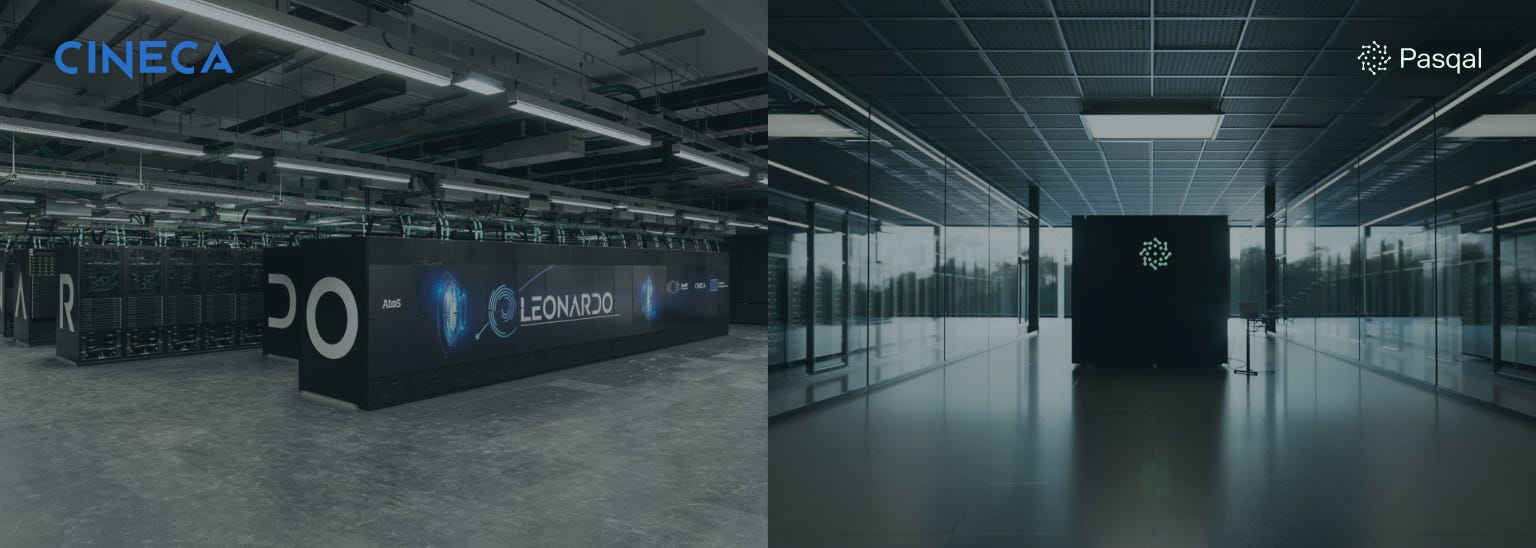
Pasqal has inaugurated Italy’s first neutral-atom quantum computer, named SOL, at CINECA in Bologna—marking the third deployment of a Pasqal system in Europe. The Orion QPU features 140 qubits and is integrated with the EuroHPC Leonardo supercomputer, enabling hybrid quantum-classical workflows through established HPC scheduling and interfaces. This milestone, co-funded by the EuroHPC Joint Undertaking and Italy’s Ministry of University and Research, signals a significant advance in Europe’s quantum computing infrastructure.
Google declines to join Trump administration’s $2 billion quantum computing initiative due to speed concerns
Google is staying out of President Donald Trump’s $2 billion quantum computing funding initiative, and the decision could say as much about speed as it does about strategy. Speaking at the Semafor Tech Summit in San Francisco on June 10, Google Quantum AI COO Charina Chou said Google declined to join because various conditions that came with the funding could have slowed the company’s push to build a practical quantum computer. Chou added that Google still works with Washington in other ways and supports more funding for basic quantum research.
University of Tennessee Knoxville announces plan for 100,000-square-foot quantum accelerator facility

The University of Tennessee, Knoxville, is the latest major institution to announce an investment in new quantum research infrastructure, with plans to build a 100,000-square-foot facility and hire new faculty members to establish a regional quantum hub in Knoxville. In addition to personnel investments, the initiative includes plans for a 100,000-square-foot quantum foundry at UT Research Park and another quantum computing hub in Knoxville’s Maplehurst Innovation District.
Why Quantum Computing Companies Are Turning to SPACs
Great article from TQI on why SPACs are the chosen vehicle for most Quantum companies.
IQM Finland Oy and Real Asset Acquisition Corp. secure upsized USD 146 million PIPE with new commitment from Ilmarinen
IQM Quantum Computers and Real Asset Acquisition Corp. (RAAQ) announced the upsizing of their PIPE financing to over USD 146 million, following a new investment from Ilmarinen, Finland’s largest private earnings-related pension insurance company. The capital will fund IQM’s technology and commercial efforts towards fault-tolerant quantum computing.
Silicon Quantum Computing receives 40 million AUD from National Reconstruction Fund Corporation to expand quantum chip production
SQC Secures Additional Funding for Quantum Chip Production secures 40 million AUD for quantum chip production expansion from the National Reconstruction Fund Corporation. The total investment from the government investment fund in the company has reached 60 million Australian dollars.
Alice & Bob launches Helium platform to accelerate quantum error correction and logical qubit research for superconducting cat qubits
A&B unveiled the Helium Quantum System, marking the company’s expansion from developing cat-qubit chips to delivering a complete quantum computing system for on-premise deployment. The Helium Quantum System has been engineered to encode Alice & Bob’s first logical qubit with as few as 18 cat-qubits. From the processor architecture to the cabling, control electronics and software stack, the entire system is optimized for quantum error correction. Designed as an upgradeable platform, the quantum system will also support the next 48 cat-qubit chip on Alice & Bob’s roadmap – expected to feature multiple logical qubits.
Nokia launches Deepfield Genome Shield and announces partnerships for quantum-safe key distribution and AI-enabled 5G modernization

Nokia is working with Indosat Ooredoo Hutchison and NVIDIA to modernize Indonesia’s 5G networks using AI centric technologies. The company has partnered with Quantropi to work on carrier grade, quantum safe key distribution for future resistant networking.
Arkeon Technologies raises €594.2k seed funding to enhance precision in quantum chip production
Arkeon Technologies, a DeepTech startup from Gothenburg, has secured a €594.2k (SEK 6.5 million) Seed round from Chalmers Ventures, Navigare Ventures, and Almi Invest to enhance its technology for producing precision superconducting quantum chips. Founded in 2025 by Peter Hörstedt, Andreas Nylander, and Marcus Rommel, Arkeon develops a post-fabrication method to finely tune qubit frequencies, aiming to improve chip accuracy, quality, and yield without requiring a redesign of the manufacturing process. The company has secured letters of intent from several potential customers and maintains a pipeline of around 30 interested companies, signaling strong early market interest.
Italy launches National Quantum Strategy and invests over €140 million to develop quantum technology ecosystem
Italy’s quantum technology sector has rapidly developed, fueled by over €140 million in National Recovery and Resilience Plan (NRRP) funding (2023–2025) and the establishment of two key institutions: the National Center for HPC, Big Data and Quantum Computing and NQSTI. In 2025, a National Quantum Strategy was launched, reflecting interministerial coordination, although actual budget allocations and measurable goals lag behind peers like Germany and France. The industrial quantum ecosystem is young, with strengths in quantum communication, photonics, and a growing presence of international firms (IQM, Pasqal).
Colt Technology Services and Ciena complete quantum-safe data transmission trial across transatlantic network
Colt Technology Services and Ciena have completed a successful trial of quantum-safe data transmission over a transatlantic route, protecting live data across 6,900 kilometers of Colt’s subsea and terrestrial network between New York and London. The trial demonstrated secure transmission at an 800 Gb Ethernet service rate using Ciena’s WaveLogic 6 Extreme encryption, which features Module-Lattice-Based Key-Encapsulation Mechanism (ML-KEM) algorithms, recently standardized by NIST, and Quantum Key Distribution interworking. The effort addresses growing concerns over quantum computing potentially breaking current encryption by 2030 and safeguards high-value data transmitted via subsea cables.
Horizon Quantum Announces Dublin as Its Second Quantum Computer Testbed Location, Bringing A Frontier Quantum System to Ireland
Horizon Quantum infrastructure for quantum applications, today announced that it expects to locate its second quantum computer—anticipated to be one of the most advanced commercial quantum systems in the world—in Dublin, Ireland. By placing this IonQ 256-qubit system at its European headquarters, Horizon Quantum aims to benefit from Ireland’s growing quantum ecosystem, strong university network, and robust talent pool for deep-tech development, both within the country and across the EU.
IQM Quantum Computers unveils barbell quantum error-correcting codes to reduce hardware complexity for fault-tolerant quantum computing
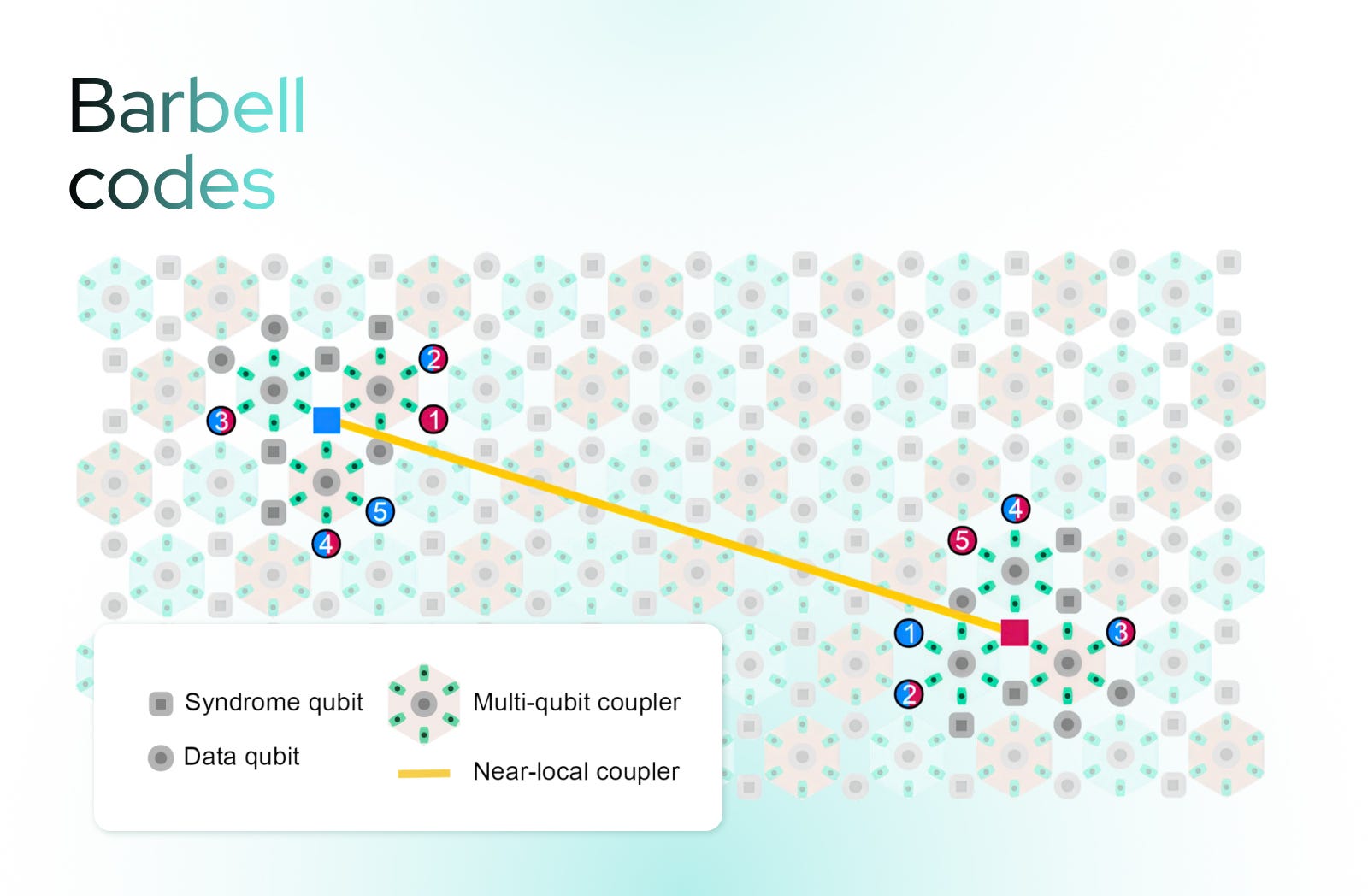
Unlike many alternative high-performance quantum error-correction approaches, the new code also maintains a comparatively low hardware complexity, marking a significant advancement toward scalable fault-tolerant quantum computing. Quantum error correction remains one of the defining challenges in the race toward practical quantum computing. IQM’s breakthrough technology, called barbell codes, is a family of quantum low-density parity-check (QLDPC) codes tailored to IQM’s Constellation, a unique quantum processor topology with enhanced planar connectivity where each qubit can natively interact to 12 other qubits.