
Oratomic, IM, Max Planck, Rigetti, QTech and more - The Week in Quantum Computing, July 13th 2026
Issue #289

This week, quantum research cut through wishful thinking with an unambiguous leap in theory and some increasingly pointed moves in education and collaboration. In a result years in the making, Mark Zhandry, John Bostanci, Jonas Haferkamp, and Chinmay Nirkhe have delivered the first proof—free of hand-waving or controversial complexity assumptions—that for certain problems, no classical certificate can ever substitute for a quantum one. Their marathon paper on the “spectral forrelation problem” shows that quantum proofs aren’t just marketing—they’re mathematically required in some cases (Quanta Magazine). Clear signal: quantum verifiability isn’t just a performance optimization, it’s sometimes the only way in. Elsewhere in academia, the Rice University–Max Planck Society (Q-RaMP) tie-up invites us to watch basic science and actual talent pipelines take priority over empty “ecosystem” rhetoric. Their partnership, inked in Paris, is all about keeping quantum materials research young and cross-pollinated; expect joint faculty, not just grant applications (Max Planck). At the other end of the education spectrum, Alfred University and Classiq have set up camp to drag quantum software out of the specialist echo chamber and into “normal” engineering curricula. Their explicit goal: let students and researchers use quantum as a tool, not an arcane puzzle—spanning practical fields like grid optimization and advanced materials (Alfred University). Meanwhile, industrial engagement is getting some structure in Germany, where Fraunhofer’s INQUBATOR (god knows it is forbidden to name something in Quantum without the Q) is soliciting use cases from business, promising case-by-case algorithm development and real hardware access for selected partners (EurekAlert). Fewer workshops, more actual working code. On the commercial front, the line between bravado and backbone is getting starker. Oratomic emerged from stealth with a $300 million Series A and a crystal-clear play: only build a fault-tolerant quantum computer, ignore toy milestones, and automate away as much of the grind as possible with artificial intelligence (Oratomic). Impressive capital, uncompromising mandate. Contrast this with the enduring spectacle of quantum companies chasing SPAC deals—Quantum Art and Classiq each want multi-billion-dollar Wall Street debuts, per sources (notably, if you hunt the source text, hard numbers drop off). This is where the press release fog gets thick. Rigetti Computing, by contrast, is making respectable noise backed by harder numbers. Its 108-qubit Cepheus-1 system is “one of the world’s leading commercially available gate-based quantum computers,” now accessible across Amazon Braket, Microsoft Azure Quantum, and on-prem. Cash reserves stand at $569 million—enough to matter (Rigetti). The move signals a pragmatic shift: less PowerPoint, more real deployments. The U.S. government wants its cut of the action, too. A White House executive order is now on the table, aimed at snapping up quantum discoveries for actual use, not just headline-chasing. Expect new procurement models and a readiness to invest hundreds of millions via agencies like Defense Innovation Unit, targeting quantum sensing, timing, and national security. The angle is simple: use government purchasing power to shape and accelerate the market. Finally, in an application example with real market data, JPMorgan Chase—collaborating with Amazon—pushed an ambitious quantum-informed portfolio selection pipeline live on trapped-ion hardware from Quantinuum. Their hybrid qReduMIS algorithm and actual stock correlation graphs produced notably high success and approximation ratios, and—unlike vanilla quantum optimization methods—scaled better with real, dense input (arXiv). This is not spin; it’s a technical exercise with quantifiable output. Here is the important part: The gap between quantum wishful thinking and quantum in-the-world is getting a little smaller—but only where theory, hardware, and sober investment are all present and accounted for. The real game is forcing the discipline to show its work—and this week, a few players actually did.
Quantum Bits with Quantessa & Atomique
Quantum Speedup
Latest strip published July 12, 2026 · by Yuval Boger
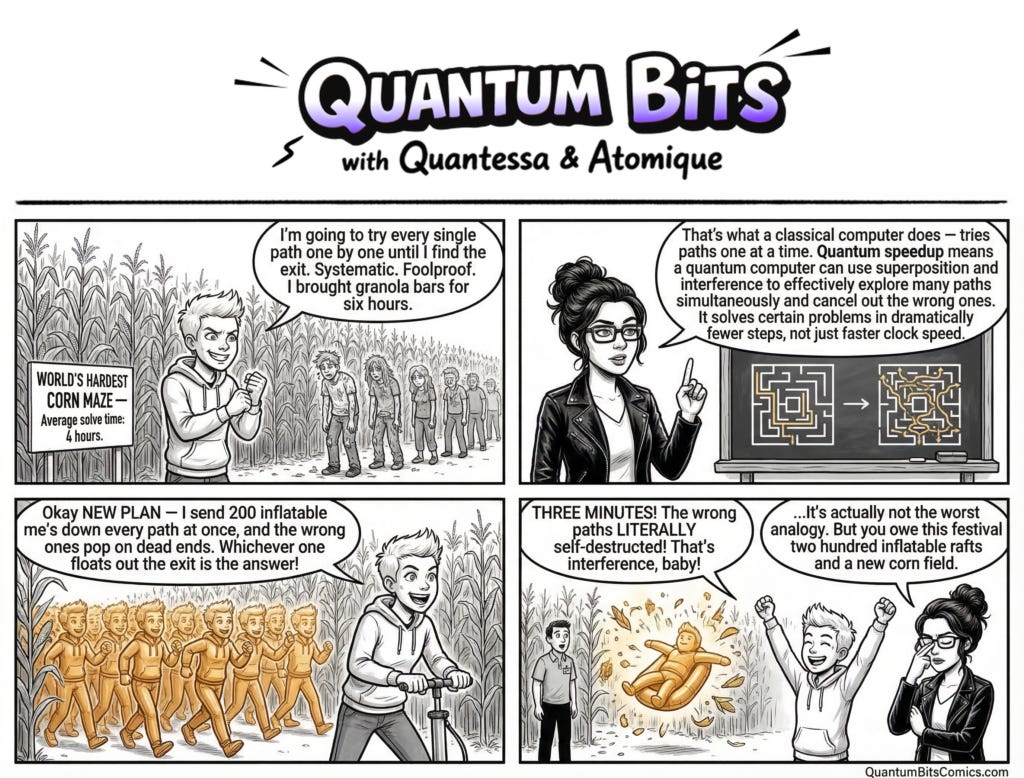
Quantum computing is not a faster version of classical computing. If you could run a standard word processor or web browser on a quantum machine, it would likely run slower than it does on your smartphone. The concept of quantum The post Quantum Speedup first appeared on quantumbitscomics.com .
Read the full comic on Quantum Bits Comics
Mark Zhandry, Chinmay Nirkhe, John Bostanci, and Jonas Haferkamp prove quantum proofs are strictly more powerful than classical proofs for specific problems

A team of researchers—including Mark Zhandry, John Bostanci, Jonas Haferkamp, and Chinmay Nirkhe—have proven that there exist computational problems that fundamentally require quantum proofs, not just classical certificates. Their 100-page paper, awarded at the 2026 Symposium on Theory of Computing, focuses on the ‘spectral forrelation problem’, where only a quantum state serves as a valid proof due to the irreducible complexity stemming from quantum superposition and measurement disturbance. This work confirms, for the first time without controversial assumptions, that quantum proofs are categorically more powerful than classical ones.
Toward Quantum-Augmented Databases: New USC Study Aims to Break the Bottlenecks Slowing Modern Data Systems
Quantum Future Modern database systems are struggling to maintain real-time performance as data volumes and workloads continue to grow exponentially. Titled “Toward Quantum-Augmented Database Systems,” the five-year project is supported by a $627,250 NSF CAREER Award and will contribute to USC’s broader quantum computing initiatives , an area in which Sabek is heavily involved. His team has access to more than 10 IBM quantum processors and the D-Wave Advantage system, enabling researchers to work with cutting-edge technologies as they seek to move quantum computing from a largely theoretical field into practical systems engineering.
Rice University and the Max Planck Society launch international partnership on quantum materials research
Rice University and the Max Planck Society have launched the Quantum Materials – Rice and Max Planck Partnership (Q-RaMP) to advance basic research and accelerate innovation in quantum materials. Signed in Paris by Max Planck Society Vice President Claudia Felser and Rice President Reginald DesRoches, the initiative will support the identification and development of novel materials for computing, sensing, and energy technologies. The partnership emphasizes fostering young researchers through joint faculty hiring, graduate student exchanges, workshops, and collaborative working groups.
[PAPER] QuTech and Delft team nail 99.92% fidelity spin readout in silicon MOS dot
![[PAPER] QuTech and Delft team nail 99.92% fidelity spin readout in silicon MOS dot—340 microseconds, industrial 300-mm wafer, compact sensor raises the stakes for scalable quantum arrays](https://substackcdn.com/image/fetch/$s_!-S-V!,f_auto,q_auto:good,fl_progressive:steep/https%3A%2F%2Fsubstack-post-media.s3.amazonaws.com%2Fpublic%2Fimages%2F2eeef37a-84b0-48a2-8d91-dbdc9745080c_685x522.png "[PAPER] QuTech and Delft team nail 99.92% fidelity spin readout in silicon MOS dot—340 microseconds, industrial 300-mm wafer, compact sensor raises the stakes for scalable quantum arrays")
Metal–oxide–semiconductor (MOS) technology offers a promising route to scalable quantum computing based on spin qubits, but large-scale architectures require compact and sensitive sensors that preserve qubit connectivity and remain compatible with industrial fabrication. Here we demonstrate a dispersive spin–qubit sensor, a single-electron box (SEB), integrated within a bilinear unit cell of planar MOS quantum dots fabricated using an industrial 300-mm wafer process. Independent gate control of the SEB and double-quantum-dot tunnel rates enables optimization of the sensor, achieving state-of-the-art dispersive readout fidelities of 99.92% in 340 μs and 99% in 20 μs. We also develop a hidden Markov model of the two-electron spin dynamics, allowing a more accurate determination of the measurement outcome and corresponding fidelity. Our results show that the compactness and versatility of SEB-based charge sensing can be realized without compromising sensitivity, providing a scalable pathway for future MOS spin–qubit architectures.
Alfred University partners with Classiq to launch quantum computing initiative for engineering education and research
Alfred University and Classiq have launched a joint quantum computing initiative, announced July 7, to integrate Classiq’s quantum software engineering platform into engineering education and research. The collaboration aims to make quantum computing accessible to students and researchers without requiring deep coding skills, with applications in renewable energy, ceramics, glass, and materials science. Assistant Professor Junpeng Zhan has introduced the platform in courses and research, addressing energy grid optimization problems, and collaborating on NSF- and ISO-New England-funded projects.
Quantum Rings and qBraid partnership offers $50 in free quantum compute via Open Quantum integration
Tens of thousands of users of the qBraid quantum-cloud computing platform now have access to $50 in free quantum processing unit (QPU) compute through a new integration with Quantum Rings’ Open Quantum platform. The partnership, announced July 9, 2026, unlocks access to QPUs from IonQ , Rigetti , IQM , and AQT , offering developers and researchers a unified interface to explore diverse quantum architectures. By lowering barriers to experimentation with free and subsidized time, the collaboration aims to broaden participation in quantum computing and accelerate application development across multiple quantum systems.
[PAPER] Google Quantum AI taps reinforcement learning to boost real-time quantum error correction
![[PAPER] Google Quantum AI taps reinforcement learning to boost real-time quantum error correction—3.5× error rate stability, record 7.72×10⁻⁴ per-cycle logical error on superconducting surface code Here is the important part: real-time RL calibration cuts disruptions and shows credible scaling, but can’t outrun fast hardware drift—brute physical stability is still non-negotiable.](https://substackcdn.com/image/fetch/$s_!xllO!,f_auto,q_auto:good,fl_progressive:steep/https%3A%2F%2Fsubstack-post-media.s3.amazonaws.com%2Fpublic%2Fimages%2F8a48a3d6-19a7-44b7-868a-86f3e8e6963e_685x260.png "[PAPER] Google Quantum AI taps reinforcement learning to boost real-time quantum error correction—3.5× error rate stability, record 7.72×10⁻⁴ per-cycle logical error on superconducting surface code Here is the important part: real-time RL calibration cuts disruptions and shows credible scaling, but can’t outrun fast hardware drift—brute physical stability is still non-negotiable.")
Quantum error correction (QEC) is the primary strategy for protecting a quantum computer from the environment1,2. The prerequisite of QEC is that errors must remain sufficiently rare, which requires perpetually adapting the control parameters of the computer to the drifting environmental conditions. The current solution to this problem is to terminate the entire quantum computation for recalibration, but it is incompatible with the long runtimes of future quantum algorithms3,4. Here we address this challenge by unifying calibration with computation. We grant the QEC process5,6,7,8,9,10,11 a dual role: its error-detection events are not only used to correct the logical quantum state but are also repurposed as a learning signal, teaching a reinforcement learning agent12,13,14,15,16 to continuously steer the control parameters and stabilize the quantum system during computation. We experimentally demonstrate this framework on a Willow superconducting processor, improving the logical stability of the surface code 3.5-fold against injected drift. By synthesizing our full suite of technological advances, we achieve record performance of the surface and colour codes, with average logical error per cycle of 7.72(9) × 10−4 and 8.19(14) × 10−3, respectively. Numerical simulations of large codes with tens of thousands of control parameters confirm the scalability of our RL framework, revealing an optimization speed that is independent of system size. This work thus enables a new paradigm: a quantum computer that learns from its errors and never stops computing.
JPMorgan Chase and collaborators validate quantum-informed portfolio selection pipeline on trapped-ion hardware using real market data
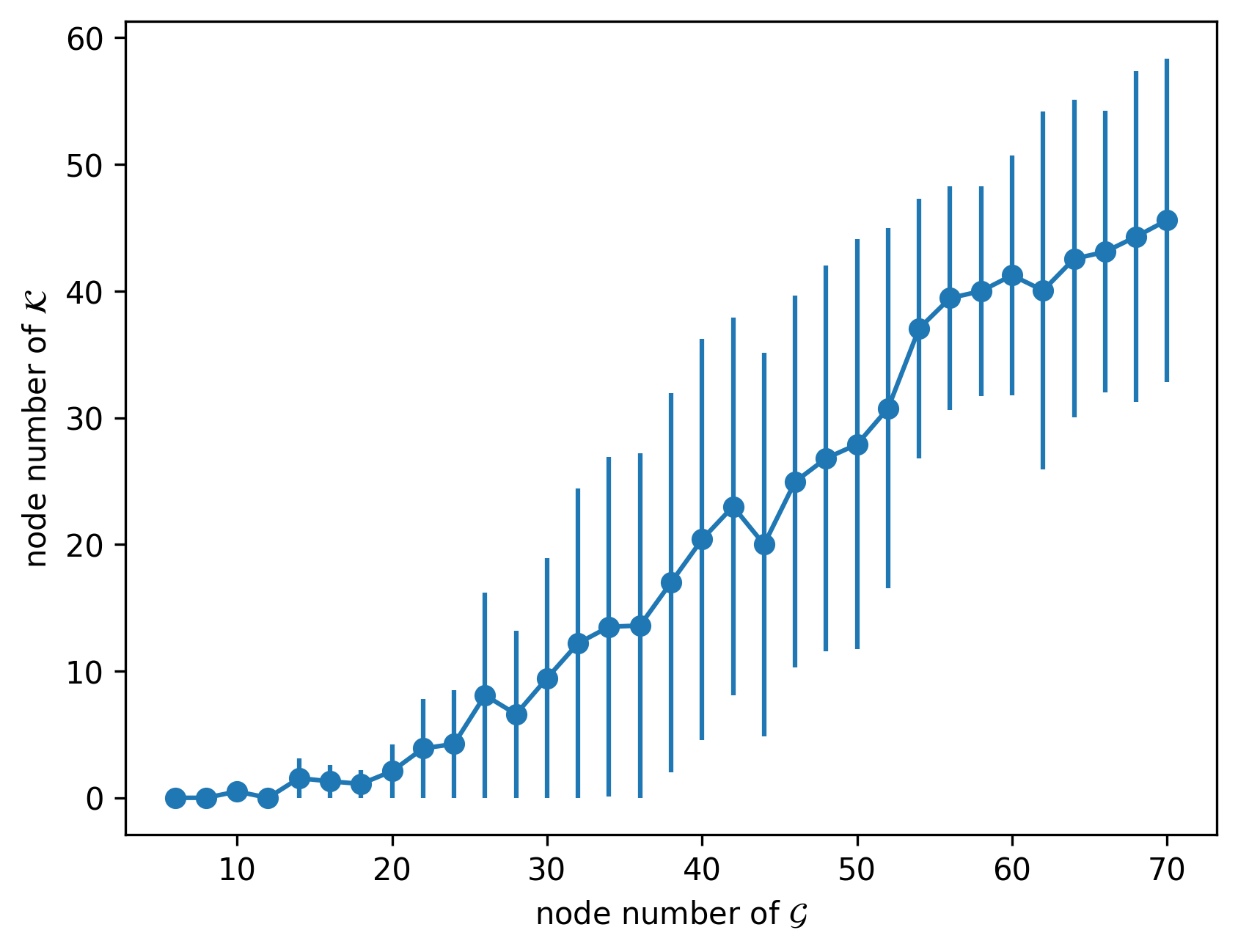
Researchers from JPMorgan Chase and Amazon Advanced Solutions Lab present an end-to-end pipeline for quantum-informed portfolio selection, mapping the task to the Maximum Independent Set (MIS) problem on dense asset correlation graphs. Leveraging the recursive hybrid quantum-classical qReduMIS algorithm, the solution uses Quantinuum’s 98-qubit trapped-ion Helios hardware and real financial data from four major market indices. Standalone QAOA could not optimally solve the largest indices, but qReduMIS achieved success probabilities up to 0.95 and average approximation ratios of at least 0.96.
Fraunhofer opens application period for industry partners to submit quantum computing use cases
Fraunhofer’s INQUBATOR center has opened applications to businesses of all sizes seeking to develop quantum computing use cases. Until August 31, 2026, companies can apply, regardless of prior experience or hardware, to collaborate with Fraunhofer Institutes in developing and testing quantum algorithms using various international quantum computers. At least four new use cases will be selected, each to receive a tailored exploitation plan and collaborative development over approximately ten months.
IQM Quantum Computers Acquires Assets of Quantistry GmbH to Bridge the Gap Between Quantum Algorithms and Solutions for Industrial Enterprises
This is a strategic asset acquisition comprising proprietary software and intellectual property of Quantistry GmbH, a pioneer in cloud-native, AI-powered chemical and materials simulation By integrating Quantistry’s advanced simulation platform with IQM’s leading quantum computing hardware, IQM will deliver an end-to-end quantum-classical applications development platform and algorithm libraries powered by a user-friendly native-AI computing environment The transaction secures a critical enterprise software layer that accelerates IQM’s application roadmap, enabling industrial enterprises to develop quantum application proof-of-concepts and scale them over time, backed by a reliable, long-term quantum roadmap It also enhances IQM’s ability to deepen domain expertise across specific industry verticals Quantistry’s core quantum chemistry and machine learning engineering team will join IQM, strengthening the company’s ability to deepen relationships with tier-one industrial enterprises across Europe and globally
MagiQware raises €575,000 pre-seed funding to advance AI-driven quantum error correction
MagiQware has secured €575,000 in pre-seed funding led by Graduate Ventures, with participation from Delft Enterprises B.V., to address a core challenge hindering the advancement of practical quantum computers. The startup is focused on optimizing a critical component of quantum error correction, and early results demonstrate up to a 40% reduction in circuit length through a novel combination of reinforcement learning and quantum compiler optimization. The new funding will accelerate the development of MagiQware’s technology and foster collaborations within the growing quantum computing industry.
Bosch Ventures joins Quantum Motion’s $160 million Series C funding round
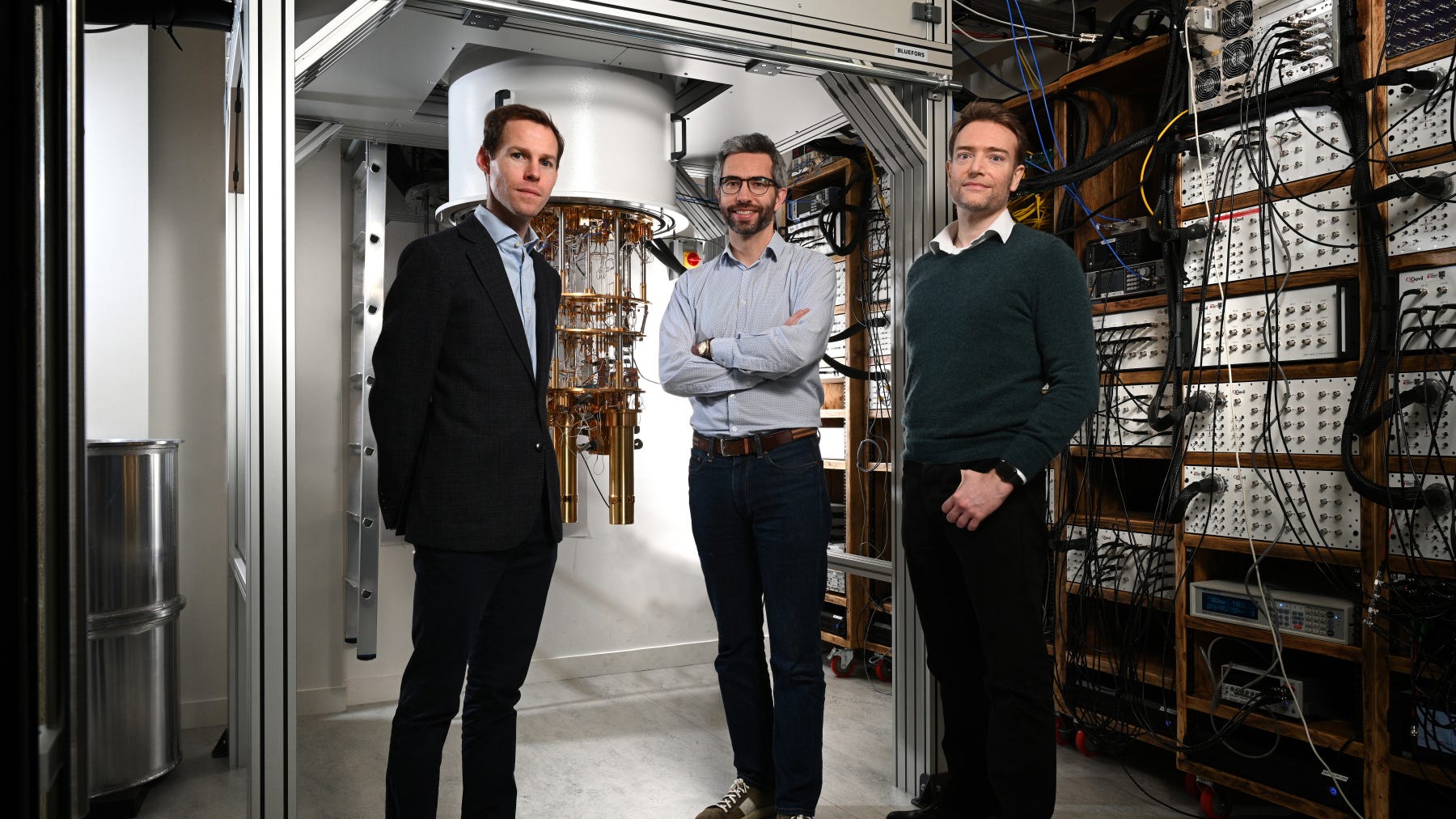
Silicon-based approach sets new benchmarks for cost, footprint, and energy efficiency in next-generation computing. Bosch Ventures already led the 2023 USD 50 million Series B financing round in the London based deep-tech startup. Dr. Ingo Ramesohl, Managing Director at Bosch Ventures. “By leveraging silicon, the team is bringing quantum computing onto a path that is both technologically compelling and economically sustainable.”
Oratomic raises $300 million in Series A funding to build a fault-tolerant quantum computer
Oratomic has secured a $300 million Series A funding round, co-led by ARCH Venture Partners, Spark Capital, Khosla Ventures, and joined by notable investors including Bezos Expeditions, Index Ventures, General Catalyst, and others. The company is focused solely on building the world’s first fault-tolerant quantum computer using a new approach to quantum error correction based on reconfigurable atomic arrays in laser beams. Oratomic is expanding its team and leveraging artificial intelligence to automate both research and quantum computer design, with a mission to achieve groundbreaking advances without pursuing intermediate commercial products.
Rigetti Computing expands access to 108-qubit quantum system through multiple cloud platforms and on-premise deployments
Rigetti Computing’s Q1 2026 results indicate a strategic pivot from focusing solely on quantum hardware to facilitating broader customer access and adoption. The release of its 108-qubit Cepheus-1 system, now available through Rigetti Quantum Cloud Services, Amazon Braket, Microsoft Azure Quantum, and qBraid, positions it as one of the world’s leading commercially available gate-based quantum computers. The company holds $569 million in cash, supporting ongoing technology investment and expansion.
White House issues executive order to boost quantum technology commercialization through government demand
The White House has issued an executive order aimed at accelerating the commercialization of quantum technologies by expanding government involvement and updating the national quantum strategy. Initiatives include the Quantum Computer for Application Development and Discovery Science (QC-ADDS) and a Defense Innovation Unit program that could invest up to $200 million in quantum sensing and timing technologies. The order emphasizes public-private partnerships, new procurement models like advance market commitments, and a focus on deploying real-world quantum capabilities beyond research, particularly for national security and commercial applications.
U.S. National Science Foundation launches Project Triad to integrate and commercialize quantum sensing, networking, and computing
The U.S. National Science Foundation (NSF) has unveiled Project Triad, a new initiative aimed at combining quantum sensing, quantum networking and quantum computing into a single operational platform. Integrating the quantum stack Rather than advancing quantum sensing, networking and computing as separate technologies, Project Triad aims to integrate them into a unified system that can be refined, scaled and eventually commercialized by US industry.
Quantum Art and Classiq pursue multibillion-dollar public offerings on Wall Street via SPAC deals
Israeli quantum startups Quantum Art and Classiq are in advanced negotiations to merge with SPACs for Wall Street listings, seeking valuations between $2 billion and $5 billion each. Quantum Art, a Weizmann Institute spin-off specializing in trapped-ion quantum computers, has raised a total of $200 million and may become the first Israeli quantum company to list, possibly before the end of 2026. Israel’s quantum ecosystem is seeing increased investment, with expectations that public listings will provide necessary capital as the industry nears commercialization.
Cloudflare commits to ML-DSA for initial post-quantum signature migration due to urgency and lack of ready alternatives
Cloudflare highlights the urgency of migrating from RSA and ECC to post-quantum cryptography to address the imminent threat posed by quantum computers. Cloudflare’s transition is underway, with most traffic already secured by ML-KEM encryption, and a goal of full post-quantum security, including signatures, by 2029. The blog emphasizes that promising new signature schemes, such as FN-DSA and those advanced to the latest NIST competition round, will not mature in time for the first migration.