

Well well well. It has been 300 editions of the Quantum Pirates (probably a few more because my numbering has been as lousy as coherence times). But all in all, a little experiment that started in September 2020, has taken us to September 2026. 300 editions almost hitting the 6 years anniversary.
Quantum has changed A LOT in the last 6 years. So so did I. Ever since I have consulted dozens of companies, started two quantum startups and built Quantum teams at two enterprises. Generative AI came in to stay and changed the field, and we have seen quite a handful claims of quantum advantage.
In this special edition (take a long coffe to read it) I will explore what has changed during all this time and publish one special every day. First, here is the “300 things I’ve learnt about Quantum”. Tomorrow you will receive the “Quantum Bullshit Detector” and after tomorrow (becuse the world keeps spinning) you will receive the usual weekly newsletter).
Looking back, every year was special in its own way. Paving the road for the next and making the industry bigger stronger.
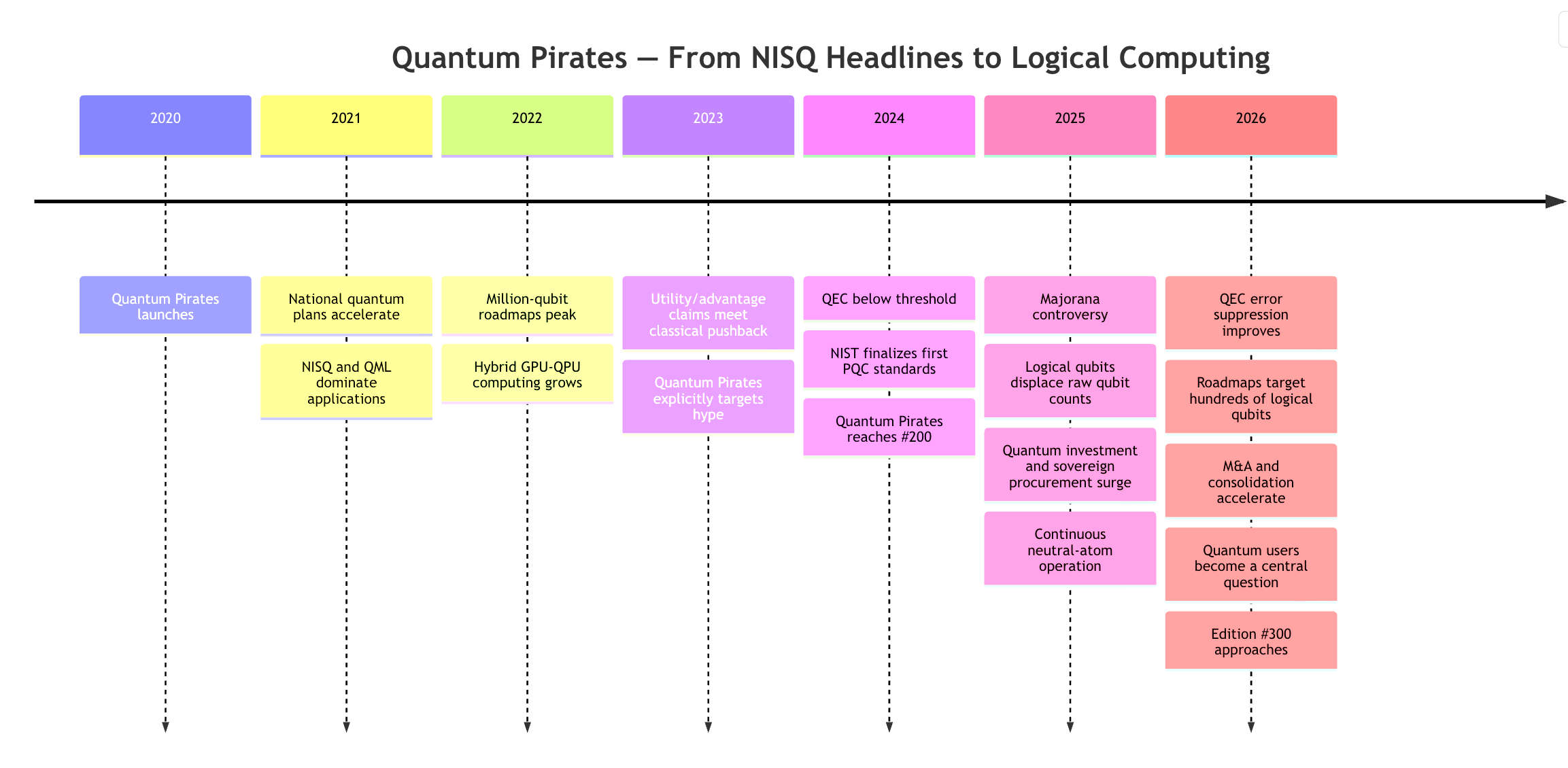
So, let’s get real. If I look back, what are the key 300 things I have learned about Quantum after 6 years writing for you?
Three hundred things Quantum Pirates learned about quantum
Hardware
001. Qubit count is a specification, not a performance benchmark.
002. A bad qubit multiplied by a thousand is still bad news.
003. Logical qubits matter more than physical-qubit bragging rights.
004. Error rate determines how much of your machine actually exists computationally.
005. Connectivity can compensate for, or magnify, the pain of gate errors.
006. Coherence time without gate speed is only half a metric.
007. Gate fidelity without circuit depth is only half a story.
008. Physical scale and computational scale are different quantities.
009. Error correction turns hardware quality into an exponential economic issue.
010. Below-threshold operation matters more than another round-number qubit milestone.
011. The best architecture is the one that survives scaling, not the prettiest lab demo.
012. Superconducting qubits traded early scale for brutal cryogenic engineering.
013. Trapped ions traded gate speed for exceptional control and connectivity.
014. Neutral atoms turned atom count into a strength but made loss and control central problems.
015. Photonics makes networking natural and deterministic computation difficult.
016. Silicon’s real attraction is manufacturing inheritance, not just small qubits.
017. Cat qubits attack the problem by engineering noise bias before coding it away.
018. Topological qubits remain extraordinary precisely because proving them is extraordinary.
019. Annealing and universal gate-model computing should not share performance vocabulary carelessly.
020. Every modality hides its own version of “the hard part.”
021. Scaling control electronics can become harder than scaling the qubits.
022. Wiring is a quantum-computing problem.
023. Refrigeration is a quantum-computing problem.
024. Packaging is a quantum-computing problem.
025. Calibration is a quantum-computing problem.
026. Yield is eventually a quantum-computing problem.
027. Manufacturing repeatability matters more as systems leave physics labs.
028. Modular architectures exist because monolithic scaling hurts.
029. Networking modules shifts difficulty; it does not abolish it.
030. Distributed quantum computing will need networking metrics as rigorous as gate metrics.
031. Losing atoms is tolerable only if the architecture knows how to replace them.
032. Continuous operation is a system-level breakthrough, not merely an uptime statistic.
033. A processor that runs for minutes and one that can run indefinitely are different engineering products.
034. Real-time decoding is part of the computer, not an optional post-processing step.
035. Quantum error correction is simultaneously a physics, hardware and classical-compute workload.
036. Better physical fidelity can save enormous numbers of future physical qubits.
037. The most valuable qubit improvement may be the one that reduces QEC overhead.
038. Logical cycle time will become a competitive metric.
039. Logical error per operation will become more important than physical gate fidelity.
040. “How many reliable operations?” is better than “How many qubits?”
041. Roadmaps have improved because they increasingly target logical workloads, not decorative qubit counts.
042. A roadmap with error budgets is better than a roadmap with a giant integer.
043. Hardware leadership can change depending on which metric you choose.
044. There may never be one winning qubit modality.
045. The winning computer will be a system, not a qubit.
Algorithms
046. A quantum algorithm is not a quantum advantage.
047. Polynomial speedup can matter more commercially than exponential rhetoric suggests.
048. Asymptotic complexity does not pay today’s cloud bill.
049. State preparation can eat the advantage before the algorithm starts.
050. Readout can eat the advantage after the algorithm finishes.
051. Oracle assumptions deserve the same scrutiny as gate counts.
052. A beautiful asymptotic speedup can hide an impossible constant.
053. Resource estimation is where elegant algorithms meet engineering reality.
054. Fault-tolerant gate counts are often more informative than logical-qubit counts alone.
055. T-count once mattered because expensive gates matter; the general lesson survives code changes.
056. Variational algorithms taught the industry a lot even when they failed to deliver advantage.
057. Barren plateaus were an early warning against assuming optimization automatically scales.
058. Noise can flatten the useful optimization landscape before qubit count becomes impressive.
059. Hybrid does not automatically mean useful.
060. “Quantum-inspired” can be commercially useful without proving anything about quantum speedup.
061. Classical algorithms improve when quantum researchers give them interesting targets.
062. Every claimed quantum advantage launches a classical optimization contest.
063. The classical baseline should be updated until the paper is published—and after.
064. Sycamore taught us that the baseline can age faster than the quantum hardware.
065. IBM’s utility debate taught the same lesson in a different benchmark.
066. Sampling advantage is not optimization advantage.
067. Optimization advantage is not financial value.
068. Chemistry remains compelling because nature does not offer an obvious cheap classical representation.
069. Quantum simulation remains the application category with the strongest first-principles argument.
070. Factoring is strategically important even if nobody plans to sell RSA factoring as SaaS.
071. Grover’s algorithm is useful—and far less magical than “search everything simultaneously.”
072. Quadratizing a problem does not make it quantum.
073. Mapping a business problem to an Ising model is not the difficult part.
074. Benchmark design can manufacture apparent advantage.
075. A benchmark should be difficult for the best competing method, not merely convenient for the QPU.
076. Approximation quality matters as much as runtime.
077. End-to-end workflow performance beats kernel-level speedup.
078. Quantum algorithms need error budgets just as hardware does.
079. The application that wins may look boring to theorists and valuable to users.
080. Algorithmic progress is increasingly about co-design with hardware.
Funding
081. Quantum is capital intensive before it is revenue intensive.
082. That combination produces spectacular financing narratives.
083. Funding validates investor appetite, not technical claims.
084. Valuation is not a hardware benchmark.
085. A billion-dollar company can still have a science problem.
086. A brilliant laboratory can still have a financing problem.
087. Public markets force research roadmaps to collide with quarterly reporting.
088. SPACs compressed decades-long technology uncertainty into investor decks.
089. Forecast revenue and booked revenue deserve separate columns.
090. Contract ceiling and recognized revenue are not synonyms.
091. Government grants can be strategically more important than venture rounds.
092. Sovereign quantum procurement is becoming industrial policy.
093. Defence funding changes the economics of long-horizon hardware.
094. CHIPS-style programmes show quantum entering semiconductor policy.
095. Public capital can preserve multiple hardware modalities long enough for the science to mature.
096. Too little capital kills hard tech.
097. Too much indiscriminate capital can preserve bad theses.
098. The funding winner is not automatically the technical winner.
099. The technical winner is not automatically the equity winner.
100. The equity winner is not automatically the application winner.
101. Follow-on funding is more informative than a glamorous seed round.
102. Strategic investors often reveal where integration bottlenecks live.
103. Acquisitions reveal which capabilities large platforms cannot build quickly enough.
104. IBM’s HRL acquisition is a sign that talent and device IP can be strategic assets.
105. Consolidation is not necessarily failure; immature industries consolidate.
106. Deep-tech investors need different clocks from SaaS investors.
107. Quantum revenue today often comes from access, research, services and government contracts.
108. Calling all of that “commercial quantum advantage” confuses market activity with computational advantage.
109. Picks-and-shovels businesses may mature before universal QPUs.
110. Cryogenics, lasers, control, fabrication and security can monetize independently of fault tolerance.
Hype
111. The dangerous quantum claim is usually 80% true.
112. Hype lives in the final 20%.
113. “World first” is often a search-query optimization problem.
114. “Breakthrough” should describe an obstacle removed, not a press-release publication date.
115. “Revolutionary” is not an SI unit.
116. “Quantum advantage” without a workload is meaningless.
117. “Commercial advantage” without economics is flat marketing.
118. “Useful” without a user is suspicious.
119. “Fault tolerant” without logical-error evidence needs interrogation.
120. “Quantum-ready” usually says more about procurement than computing.
121. Qubit numbers generate headlines because they are easy to compare.
122. Easy-to-compare metrics are often easiest to game.
123. The metric a vendor leads in is often the metric its press release emphasizes.
124. No company voluntarily headlines its worst bottleneck.
125. That’s why cross-vendor metrics matter.
126. A roadmap is not a lie because it is ambitious.
127. A roadmap becomes hype when journalism changes “plans to” into “has.”
128. A milestone without a deadline is a wish.
129. A deadline without dependencies is theatre.
130. A forecast without probabilities is a story pretending to be a model.
131. Market-size forecasts deserve bigger error bars than quantum experiments.
132. “Billions by 20XX” is one of quantum’s most durable literary genres.
133. Press releases systematically compress uncertainty.
134. Scientific papers systematically expand caveats.
135. Always read whichever version contains more caveats.
136. The abstract is not the paper.
137. The press release is definitely not the paper.
138. The headline may not even be the press release.
139. A CEO quote is evidence of what the CEO believes, or wants you to believe.
140. Independent replication is where adjectives go to die.
141. Skepticism is useful only when it is technically specific.
142. “Quantum will never work” is hype with the sign reversed.
143. Being anti-hype is not permission to ignore real progress.
144. Google’s QEC work is exactly why blanket skepticism is intellectually lazy.
145. Majorana 1 is exactly why blanket credulity is equally lazy.
People
146. Quantum computing is a team sport disguised as a physics story.
147. No single discipline can build the full machine.
148. Theoretical physicists need fabrication engineers.
149. Fabrication engineers need control engineers.
150. Control engineers need compiler engineers.
151. Compiler engineers need algorithm researchers.
152. Algorithm researchers need domain experts.
153. Domain experts need people who understand classical alternatives.
154. Everyone eventually needs someone who understands the customer.
155. “Quantum talent” is therefore much broader than quantum physicists.
156. A strong founder cannot repeal physics.
157. A strong scientist is not automatically a strong CEO.
158. A strong CEO is not automatically a reliable scientific narrator.
159. The best teams separate scientific uncertainty from commercial confidence.
160. Hiring from adjacent industries is a feature, not contamination.
161. Semiconductor expertise is becoming more valuable as quantum scales.
162. HPC expertise is becoming more valuable as quantum integrates.
163. Cryptographers became central before cryptographically relevant quantum computers arrived.
164. Error-correction researchers moved from theory slides into system roadmaps.
165. Product managers will matter more when users finally have choices.
166. Talent mobility is one of the best leading indicators of emerging subfields.
167. Acqui-hires can reveal technical bottlenecks better than marketing does.
168. National ecosystems compete for people before they compete for machines.
169. Training thousands of people matters even when only hundreds design qubits.
170. The quantum workforce will be built partly by people who never took a quantum-mechanics degree.
Policy
171. Quantum became industrial policy before it became a large industry.
172. Governments fund quantum partly because waiting for the market is strategically risky.
173. National strategies are now table stakes.
174. A strategy without procurement is easier to announce than to execute.
175. A strategy without talent policy is incomplete.
176. Quantum sovereignty is really a supply-chain question.
177. Cryogenics sovereignty can matter as much as qubit sovereignty.
178. Foundry access is strategic.
179. Laser and photonics supply chains are strategic.
180. Control electronics are strategic.
181. Export controls can shape architecture choices indirectly.
182. Government procurement can create the first customer for immature platforms.
183. National laboratories are natural bridges between QPUs and HPC.
184. EuroHPC signals that Europe sees quantum as part of computing infrastructure.
185. DARPA-style milestone funding is better aligned with engineering uncertainty than generic promises.
186. PQC policy is already operational rather than speculative.
187. NIST standardization changed the question from “which algorithms?” to “how do we migrate?”
188. Cryptographic inventory is a quantum-readiness project you can perform today.
189. Crypto-agility may matter more than predicting the exact Q-day.
190. Waiting for a cryptographically relevant machine before migrating is the wrong dependency.
191. “Harvest now, decrypt later” makes future capability a current security issue.
192. Quantum policy increasingly overlaps cybersecurity policy.
193. It also increasingly overlaps semiconductor policy.
194. And defence policy.
195. And energy policy.
196. Quantum policy should fund boring infrastructure as well as glamorous processors.
197. Testbeds can be more useful than prestige announcements.
198. Shared facilities reduce duplication in capital-intensive research.
199. Smaller countries can compete by specializing rather than cloning the full stack.
200. The geopolitical quantum race is real even when some technology claims are not.
Tooling
201. Quantum computers need classical computers to become useful.
202. Fault-tolerant quantum computers will need even more classical computing.
203. The decoder is part of the architecture.
204. The compiler is part of the performance result.
205. The scheduler is part of the performance result.
206. Calibration software is part of the machine.
207. Hardware-aware compilation can turn the same QPU into a different effective computer.
208. Circuit count is meaningless without transpilation assumptions.
209. Portability across hardware matters because nobody knows the winning modality.
210. Abstraction is useful only until it hides a performance-critical hardware fact.
211. Quantum cloud access democratized experiments before quantum usefulness.
212. Queuing time is not algorithm runtime—but users experience both.
213. API stability matters to application teams.
214. Reproducibility needs software-version provenance.
215. Benchmarks need compiler-version provenance.
216. HPC-QPU integration is more plausible than standalone quantum laptops.
217. GPUs are collaborators with QPUs, not merely competitors.
218. AI may improve calibration, control, decoding and algorithm discovery before QML changes AI.
219. Real-time control requires latency thinking foreign to many algorithm papers.
220. Data movement can erase accelerator benefits.
221. Open-source software created a workforce before there was a mature market.
222. Good simulators are weapons against quantum bullshit.
223. Better tensor networks can destroy yesterday’s advantage headline.
224. Emulators make application development possible before hardware arrives.
225. But simulated success does not imply hardware success.
226. Resource estimators should be standard developer tools.
227. Error models should be visible rather than magical configuration files.
228. Benchmark suites need to evolve as classical competition evolves.
229. Hardware vendors benefit from common performance ontologies even when rankings hurt.
230. The mature quantum stack will look less like a science experiment and more like distributed systems.
Applications
231. An application is not a use case until somebody has a reason to pay.
232. A use case is not an advantage until quantum beats the alternative.
233. A quantum speedup is not commercial value unless the bottleneck mattered.
234. Chemistry remains compelling because electronic structure is inherently quantum mechanical.
235. Materials science may produce value before consumer-facing quantum applications.
236. Drug discovery needs workflow improvement, not simply a faster molecular subroutine.
237. Optimization has enormous demand and enormous classical competition.
238. Finance is attractive because small improvements can have monetary value.
239. Finance is dangerous because classical baselines are extremely sophisticated.
240. “Portfolio optimization” is the hello-world of quantum business decks.
241. Logistics demos are easy; defensible logistics advantage is hard.
242. Scheduling is not solved merely because it can be written as a QUBO.
243. Machine learning remains one of quantum’s most overgeneralized application narratives.
244. Quantum kernels need to beat excellent classical kernels, not textbook examples.
245. Quantum generative models need a reason to exist beyond being quantum.
246. Security is already producing quantum-related spending without a useful QPU.
247. PQC is therefore one of quantum’s first genuinely large deployment problems.
248. Randomness and cryptographic primitives may provide specialized early value.
249. Quantum networking may generate security applications on a different maturity curve from computing.
250. Sensing should not be ignored merely because “quantum computing” attracts more headlines.
251. Enterprise pilots are valuable when they identify impossible requirements early.
252. A failed pilot can save years of strategic confusion.
253. The best enterprise quantum teams benchmark classical methods first.
254. Domain expertise beats generic quantum enthusiasm.
255. A customer with no classical baseline is not ready to evaluate a quantum result.
256. “Quantum-ready” should mean data, workflow, people and crypto readiness—not buying a QPU.
257. Today’s useful quantum work often consists of learning which problems not to quantum-compute.
258. Application discovery and hardware development are coupled feedback loops.
259. Early customers help hardware teams discover which metrics matter.
260. Hardware teams help customers discover which problems were fantasies.
261. The first major advantage may occur in a workload invisible to consumers.
262. Scientific value can precede commercial value.
263. Government value can precede either.
264. “Useful” has different definitions in science, defence and business.
265. Edition #295’s question—who are the users?—may be more important than asking who has the most qubits.
Failures and hard-earned lessons
266. Failure to hit a roadmap does not imply the underlying science is wrong.
267. It does imply the roadmap should be recalibrated.
268. Repeated missed roadmaps are data.
269. Refusing to update after a missed roadmap is culture.
270. Million-qubit headlines aged faster than error-correction papers.
271. Raw scale arrived sooner than useful logical scale.
272. NISQ applications arrived slower than NISQ hardware.
273. Error mitigation was useful scientifically but never equivalent to fault tolerance.
274. Variational algorithms were easier to publish than to commercialize.
275. Quantum machine learning accumulated use cases faster than unquestionable advantages.
276. Classical simulation repeatedly embarrassed overconfident benchmark claims.
277. That’s healthy science, not a defeat for quantum computing.
278. Sycamore remained important after its 10,000-year comparison collapsed.
279. IBM’s Eagle experiment remained interesting after classical competitors caught up.
280. A scientific contribution can survive the death of its marketing interpretation.
281. Physical qubits repeatedly failed as a universal comparison metric.
282. Quantum volume improved the conversation but did not end benchmarking arguments.
283. Every scalar benchmark hides architecture-specific information.
284. “Best quantum computer” remains an underspecified sentence.
285. Different applications can produce different hardware winners.
286. SPAC enthusiasm showed what happens when technology timelines meet speculative capital.
287. Financial distress does not prove a technology category is technically invalid.
288. Technical excellence does not guarantee a viable capital structure.
289. Good science can live inside a bad business model.
290. Bad science can briefly live inside a very expensive business model.
291. Topological computing taught the field that extraordinary architectures require extraordinary evidence.
292. Majorana claims should be scored on evidence, not Microsoft’s size or critics’ sarcasm.
293. Skeptics can be wrong about eventual success and right about current evidence.
294. Believers can be right about eventual success and wrong about current evidence.
295. Time separates those two statements.
296. Quantum computing has progressed enormously without yet fulfilling its largest commercial promises.
297. That is normal for genuinely hard technology.
298. The industry’s strongest progress since 2020 is that its questions have become harder and more precise.
299. The best evidence of maturity is not louder confidence; it is better error bars.
300. After 300 editions, the one rule worth keeping is: believe the experiment, audit the interpretation, and keep the receipts.
300 editions ago, quantum computing was always five years away.
Since then, qubit counts exploded. SPACs came and went. “Quantum supremacy” became “advantage”, then “utility”, then logical qubits. Governments discovered industrial policy. Cryptographers stopped waiting. Classical algorithms kept ruining perfectly good quantum headlines. And, somehow, the computers actually got much better.
Some predictions were right. Some were early. Some were marketing wearing a lab coat.
So for issue #300 we did something dangerous:
we kept the receipts.